
Key Metrics to Measure Manufacturing Marketing Success: Practical KPIs and an ROI Playbook
Marketing for manufacturers only earns its place when it drives tangible business results—qualified RFQs, purchase orders, and a steady, predictable pipeline—not vanity metrics. This guide delivers a practical, metric-first framework for marketing leaders and operations teams: which KPIs matter, how to calculate ROI, and how to build dashboards and predictive tools that turn activity into orders. At MarketMagnetix Media Group, we focus on measurable ROI; we’ll reference our Marketing For Manufacturers service as a real-world example of how metrics convert into RFQs and purchase orders. If you’re dealing with poor-quality leads, long sales cycles, or fuzzy attribution, this guide links specific metrics to the actions that fix them. You’ll get lead-generation KPIs, financial formulas and benchmarks, channel diagnostics, alignment metrics to bridge sales and marketing, AI/data use cases, and a step-by-step implementation plan to track performance and improve outcomes.
What Are the Core Lead Generation Metrics for Manufacturing Marketing?
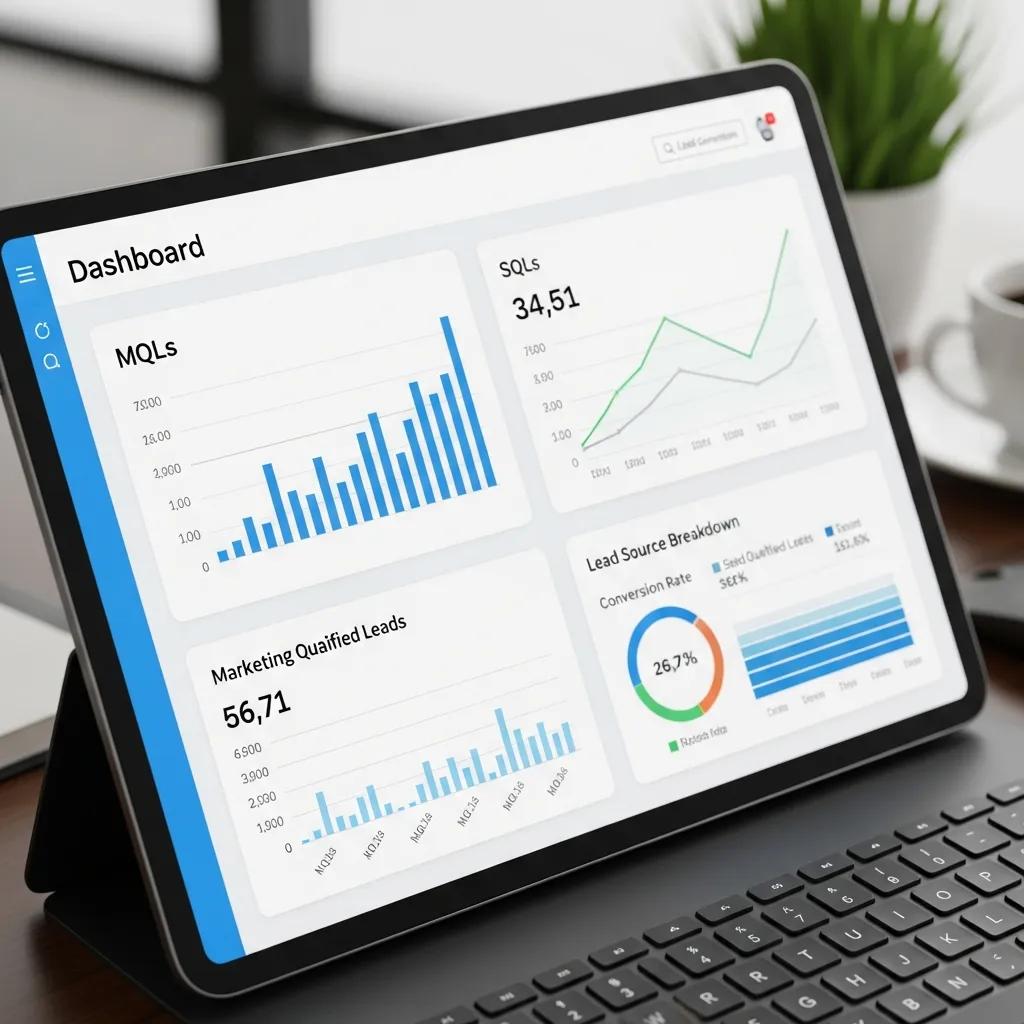
Core lead-generation metrics capture both volume and the technical quality of demand so teams can forecast revenue and focus seller time where it matters. Key measures include Marketing Qualified Leads (MQLs), Sales Qualified Leads (SQLs), Lead Velocity Rate (LVR), lead-to-opportunity conversion, and opportunity-to-win ratio—each corresponds to a funnel stage and surfaces specific bottlenecks. Reliable collection requires consistent CRM, marketing automation, and attribution data so you can act on source, technical fit, and RFQ intent. Below is a compact reference linking each primary lead metric to its data source and practical use to help teams prioritize what to measure and fix.
Quick reference: which lead metrics to pull, where to get them, and what to do with the results.
| Metric | Primary Data Sources | Actionable Use |
|---|---|---|
| MQL (Marketing Qualified Lead) | Marketing automation, form fields, behavior scoring | Target nurture programs; hand off to SDRs for technical validation |
| SQL (Sales Qualified Lead) | CRM qualification stage, sales notes | Trigger sales outreach and confirm RFQ readiness |
| Lead Velocity Rate (LVR) | CRM monthly lead counts by qualification | Guide hiring, capacity planning, and campaign scale decisions |
| Lead-to-Opportunity Rate | CRM funnel conversion reports | Identify landing-page or qualification leaks to fix |
| Opportunity-to-Win Rate | CRM closed/won records | Estimate CAC payback and optimize deal support |
How Do Marketing Qualified Leads and Sales Qualified Leads Impact Manufacturing Growth?
An MQL is a prospect who’s shown marketing-level intent and meets pre-set technical-fit criteria; an SQL is a lead sales has validated as RFQ-ready and purchase-capable. For manufacturers, definitions should include signals like part downloads, CAD requests, BOM uploads, and role-based matches (engineer, buyer, procurement). Typical lead-scoring factors: company size, industry vertical, job title, RFQ downloads, and repeat site visits—combine those signals to reach MQL status. Moving to SQL requires technical acceptance plus budget and timing indicators. Clear MQL→SQL thresholds improve pipeline quality, focus seller effort on the highest-propensity leads, protect seller bandwidth, and shorten the sales cycle.
Tracking how leads grow and move through the funnel naturally leads to monitoring lead velocity, the next diagnostic to watch.
What Is Lead Velocity Rate and Why Does It Matter for Manufacturers?
Lead Velocity Rate (LVR) tracks month-over-month growth in qualified leads and gives an early read on future pipeline and revenue. Calculate LVR as ((Qualified leads this month − Qualified leads last month) / Qualified leads last month) × 100. For example, if qualified leads rise from 40 to 60, LVR = ((60−40)/40)×100 = 50%. A steady, positive LVR signals improving marketing effectiveness and supports decisions to hire inside sales or scale paid channels; a negative LVR means you should inspect creative, landing pages, or channel performance. Aim for consistent, manageable growth that aligns with sales capacity rather than volatile spikes that overwhelm operations.
With LVR tracked, you can align resourcing to the financial metrics that prove whether marketing spend pays off.
Which Financial Metrics Prove ROI in Manufacturing Marketing?

Financial metrics show whether marketing investments convert into purchase orders and margin. Track Return on Investment (ROI), Customer Acquisition Cost (CAC), Customer Lifetime Value (CLTV), and Marketing Cost Per Sale. These measures require disciplined attribution between marketing touchpoints and closed revenue—ideally linking RFQs and orders back to campaigns. The table below lists formulas and sample benchmark values for quick implementation.
Practical formulas and example benchmarks you can apply immediately.
| Financial Metric | How It’s Calculated | Benchmark / Example Value |
|---|---|---|
| ROI | (Revenue from marketing − Marketing spend) / Marketing spend | Example: ($300k − $100k) / $100k = 200% |
| CAC | Total marketing + sales acquisition spend / New customers acquired | Example: $50,000 / 10 = $5,000 per customer |
| CLTV | Average purchase value × Purchase frequency × Average customer lifespan | Example: $30k × 1.2 × 5 = $180k |
| Marketing Cost Per Sale | Total marketing spend / Number of closed deals attributed | Example: $100k / 20 = $5,000 |
How Is Return on Investment Calculated for Manufacturing Marketing Campaigns?
ROI measures net gain from marketing relative to spend: (Attributed revenue − Marketing spend) / Marketing spend, expressed as a percentage. Accurate attribution is critical—otherwise you risk overstating returns. Example: a $50,000 campaign that produces $175,000 in closed purchase orders yields ROI = ($175k − $50k) / $50k = 250%. Keep in mind multi-touch attribution complexity: last-click under-credits upper-funnel work, while multi-touch requires integrated data. Standardize attribution windows and CRM rules to reduce variance and invest where campaigns reliably produce RFQs and orders.
What Strategies Reduce Customer Acquisition Cost in Manufacturing?
Reducing CAC means improving conversion efficiency and shifting spend toward channels that deliver better-qualified leads and higher win rates. Tactics include optimizing conversion paths, tightening technical lead qualification, running account-based marketing (ABM), and expanding technical organic content like whitepapers and part-level SEO. Conversion optimization examples: shorten RFQ forms, add purposeful qualification fields, and A/B test CTAs so the same traffic yields more qualified leads. Channel mixes often favor LinkedIn intent campaigns, targeted industrial SEO, and referral partnerships that deliver higher-quality SQLs at lower unit cost. Track every tactic against CAC and CLTV to measure payback and prioritize what raises margin on customer acquisition.
How Can Website and Digital Channel Performance Metrics Optimize Manufacturing Marketing?
Your website and digital channels are the sensors that reveal which pages and campaigns generate RFQs and technical inquiries. Focus on RFQ conversion rate, technical-content engagement, channel-attributed RFQs, and time-to-contact after form submission. For manufacturers, traffic quality—session depth, datasheet or CAD downloads, and return visits—matters more than raw volume. The table below helps technical marketing teams prioritize channels, track diagnostic metrics, and apply targeted optimizations.
Channel reference: the KPIs to track and the optimization tactics to use.
| Channel | Key Metrics | Optimization Tactics |
|---|---|---|
| Organic Search | Technical page traffic, RFQ conversion rate, keyword rankings | Optimize part-level content, add product-spec schema, and surface engineering collateral |
| Paid Search | Click-through rate, cost per RFQ, conversion on RFQ landing pages | Use tightly targeted keywords, maintain negative keyword lists, and ensure conversion tracking |
| Engagement, lead quality, MQL rate | Run ABM contact-targeted ads and promote technical case studies | |
| Email / Nurture | Open rate, CTR, re-engagement RFQs | Segment by buyer role and deliver technical sequences tied to product specs |
What Website Traffic and Conversion Rates Indicate Marketing Effectiveness?
For industrial sites, RFQ conversion and technical engagement matter more than raw bounce-rate numbers: a low-traffic page that converts RFQs is more valuable than a high-traffic page with shallow visits. Benchmarks vary, but teams typically track RFQ conversion (with monthly improvement targets), demo/contact conversion, and interactions with technical assets like CAD downloads. AB tests should focus on headline clarity, form length, and trust signals that resonate with engineers and procurement. Combine session-quality signals with conversion data to find misaligned keywords or content gaps, then iterate with data-backed hypotheses.
How Does Social Media and Email Marketing Engagement Drive Manufacturing Leads?
Social—LinkedIn in particular—builds technical awareness when content targets engineers and procurement with case studies, specs, and ROI-focused messaging; prioritize engagement quality and lead relevance over follower counts. Email nurture sequences are judged by open rate, CTR, and conversion to RFQ or demo; sequence performance feeds lead scoring and MQL movement. Example sequence: educational content → CAD download → RFQ invite—each step should raise a lead’s score toward SQL. Sync social and email signals with lead scoring to accelerate qualification and reduce wasted outreach.
What Advanced Metrics Align Sales and Marketing for Manufacturing Success?
Advanced metrics connect marketing influence to closed business with shared KPIs like MQL→SQL conversion rate, sales cycle length, pipeline velocity, and multi-touch attribution. These metrics create shared accountability and improve predictability. Pipeline velocity, for example, combines deal volume, average deal value, conversion rates, and sales cycle length into a single, forecastable metric both teams can impact. Choose an attribution model and apply it consistently so marketing gets fair credit while sales owns qualification. A shared dashboard with SLAs and a regular review cadence ensures both teams respond quickly to trends and take corrective action together.
How to Measure MQL to SQL Conversion Rate and Sales Cycle Length?
MQL→SQL conversion rate = (Number of MQLs that become SQLs / Total MQLs) × 100. This needs CRM filters that capture stage progression and timestamps so you can spot funnel friction. Average sales cycle length is the average days between opportunity creation and closed/won dates, segmented by channel or product line to show where marketing delivers quicker wins. Implementing these metrics requires CRM hygiene—clear stage definitions, timestamped events, and required qualification notes. Useful widgets include trendlines for MQL→SQL conversion, sales-cycle distribution by channel, and alerts when conversion or cycle time drifts from targets.
Why Is Sales and Marketing Alignment Critical in Manufacturing?
Alignment prevents lost deals, wasted spend, and long, unpredictable cycles by ensuring both teams share definitions, goals, and performance data. Misalignment shows up as rejected leads, duplicated outreach, or unclear account ownership. Shared SLAs—expected MQL quality, response times to SQLs, and feedback on disqualified leads—create operational discipline and measurable accountability. Tactical steps: regular SLA reviews, joint pipeline forecasting, and reciprocal KPIs that connect marketing activity to sales outcomes. When alignment works, marketing investment turns into higher-quality RFQs and faster, more predictable purchases, improving overall return on marketing spend.
How Does AI and Data Analytics Enhance Measurement of Manufacturing Marketing Metrics?
AI and analytics convert behavioral signals and historical results into predictive insights, automated attribution, and real-time anomaly detection. Predictive models forecast which leads are most likely to produce RFQs and which channels will deliver the best ROI. In practice, a model can identify high-propensity buyers or flag sudden drops in RFQs. Implementing these capabilities requires integrated data pipelines (CRM, analytics, attribution) and validation against closed-won outcomes. Key AI use cases and recommended KPIs for automated dashboards are listed below.
- Predictive lead scoring to prioritize outreach to leads with the highest RFQ propensity.
- Multi-touch attribution modeling to distribute credit across campaigns for truer ROI.
- Anomaly detection and alerting to surface sudden RFQ drops or CAC spikes.
What Role Does Predictive Analytics Play in Manufacturing Marketing?
Predictive analytics uses past CRM and behavioral data to score leads by purchase propensity, forecast pipeline, and estimate time-to-RFQ. Typical outputs include lead propensity scores, expected deal value, and churn risk, which help teams prioritize outreach and allocate resources more efficiently.
Research shows AI-driven lead propensity models can quantify prospect value from digital engagement and guide prioritization.
AI-Driven Lead Propensity for Marketing Conversion
Lead propensity prediction assigns a score to prospects based on their engagement with digital channels and attributes that correlate with buying intent. That score helps marketing and sales focus on the highest-value prospects and improves conversion rates by aligning effort with likely outcomes.
Artificial intelligence-based lead propensity prediction, M Hain, 2023
Models typically use features like technical-asset engagement, firmographics, past buying patterns, and timing signals (budget cycles, seasonality). Mini-case: a model trained on historical RFQs found CAD downloads plus two product-page visits within 14 days increased RFQ likelihood by 3×, enabling prioritized outreach. Always validate models against closed orders and retrain regularly to prevent drift as market conditions change.
Using algorithms such as Random Forest and Logistic Regression can sharpen lead scoring and improve sales efficiency when models are properly validated.
AI Lead Scoring for Manufacturing Marketing ROI
This paper examines how machine-learning methods like Random Forest and Logistic Regression improve lead scoring and qualification, reducing wasted effort and increasing conversion precision. When integrated into sales workflows, these models help prioritize leads and amplify revenue impact.
Enhancing Sales Efficiency with AI: Implementing Random Forest and Logistic Regression Algorithms for Lead Scoring and Qualification, A Sharma, 2022
How Can Automated Reporting and Real-Time Dashboards Improve Decision-Making?
Automated reports and real-time dashboards remove reporting lag and surface performance deviations so teams can act quickly. Useful widgets include MQL volume, MQL→SQL conversion rate, CAC trend, pipeline value by stage, and RFQ conversion rate by channel. Set alerts for threshold breaches—e.g., a 20% month-over-month drop in RFQs or CAC above target—so stakeholders get timely notifications and can investigate root causes. Design dashboards with progressive disclosure: high-level KPIs for leaders and drill-downs for operators. With automated dashboards, teams move from monthly guesswork to daily or hourly monitoring, enabling faster iteration and improved ROI cycles.
How to Implement and Track Effective Marketing Metrics in Your Manufacturing Business?
Implementing reliable metrics follows a clear sequence: set SMART goals, choose a focused KPI set, integrate CRM and analytics, build dashboards with alerts, and establish governance and a review cadence. Start by mapping goals (for example, increase qualified RFQs by X% in six months) to KPIs and instrument tracking so data flows consistently. The checklist below is a repeatable implementation playbook that also works as an executive featured snippet.
- Set SMART goals tied to RFQs and purchase orders with clear timelines and owners.
- Map each goal to 3–5 primary KPIs (MQLs, MQL→SQL rate, CAC, CLTV, RFQ conversion).
- Integrate CRM, marketing automation, and analytics to maintain a single source of truth.
- Build dashboards and alerts with daily/weekly widgets and a monthly review cadence.
- Establish SLAs between sales and marketing and a governance process for data quality.
Use this checklist as a repeatable framework; the next sections provide SMART examples and recommended monitoring cadence.
What Are SMART Goals and How to Set Them for Manufacturing Marketing?
SMART goals are Specific, Measurable, Achievable, Relevant, and Time-bound. Examples for manufacturing: “Increase monthly qualified RFQs from engineering by 20% within six months” or “Reduce average sales cycle length by 15% in 12 months through improved technical qualification.” Setting SMART goals requires a baseline measurement, alignment with sales targets, and agreement on attribution windows. Mini-template to copy: Objective (increase qualified RFQs), Metric (MQLs meeting technical criteria), Target (20% lift), Timeframe (6 months), Owner (marketing lead). Align goals with finance and sales so marketing activity maps directly to purchase orders and business outcomes.
Which KPIs Should Manufacturers Prioritize and How to Monitor Them?
Prioritize a small set of primary KPIs: MQL volume, MQL→SQL conversion rate, RFQ conversion rate, CAC, and CLTV, supported by metrics like lead-source performance and time-to-contact. Monitoring cadence: daily for operational alerts (form drop-offs, campaign delivery), weekly for funnel health (MQLs, LVR), and monthly for financials (CAC, ROI, pipeline value). Recommended widgets: trendlines for MQL volume, funnel conversion percentages, CAC by channel, and pipeline by stage with expected close dates. For teams that want outside help, MarketMagnetix Media Group offers consultative services to build real-time dashboards and alignment playbooks that translate metrics into RFQs and purchase orders—our client work has driven measurable lifts in qualified leads and order activity.
Frequently Asked Questions
What are the benefits of using predictive analytics in manufacturing marketing?
Predictive analytics uses historical patterns to forecast outcomes like lead conversion and potential revenue. That lets you prioritize high-propensity leads, allocate resources more effectively, and optimize campaigns for better ROI. It also helps you anticipate market shifts so you can act earlier than competitors.
How can manufacturers ensure data quality in their marketing metrics?
Data quality starts with clear metric definitions, consistent data entry, and governance. Integrate CRM and analytics to create a single source of truth, run regular audits, and automate validation checks. Train users on standards and require mandatory fields for critical events to reduce noise and improve reporting reliability.
What role does customer feedback play in refining marketing strategies?
Customer feedback provides direct signals about needs and pain points that should shape messaging, content, and product positioning. Use surveys, interviews, and case studies to refine offers and create evidence-based content that resonates—then test those changes and measure any lift in engagement and RFQs.
How can manufacturers effectively track the performance of their digital marketing channels?
Use analytics tools and UTMs to attribute traffic and conversions to specific campaigns. Monitor key KPIs—traffic source, conversion rates, engagement—and run A/B tests to learn what works. Regular reviews let you reallocate spend away from underperforming channels and toward those that produce qualified leads.
What are some common pitfalls to avoid when measuring marketing success?
Avoid over-focusing on vanity metrics (traffic, likes) instead of outcomes like RFQs and sales. Don’t skip attribution setup—without it you’ll misjudge channel performance. Also, keep KPIs aligned with changing goals and include both sales and marketing in the measurement process to prevent misalignment.
How can manufacturers leverage social media for lead generation?
On platforms like LinkedIn, share technical case studies, specifications, and ROI-focused content that speaks to engineers and buyers. Use targeted ads for ABM, promote downloadable assets, and engage directly with prospects. Measured, relevant social activity builds trust and generates higher-quality leads.