

Website Performance Insights and Monitoring
Website performance insights help you see where visitors struggle with a site. Start with loading speed, mobile usability and the actions people take. Then compare those signals with calls, forms or orders. A useful report points to a specific problem and the next check.
Performance changes after site updates, traffic spikes or hosting problems. Therefore, check important pages regularly and record what changed. Use both real visitor data and a repeatable test to judge whether a fix helped.
Ongoing Performance Monitoring
Check key pages regularly after site changes.
For a New Jersey business, website performance insights should support decisions about local pages and lead paths. Track the pages that lead to qualified inquiries, then compare them with customer feedback. This guide covers analytics tools, useful measures and practical ways to review results.
Using Analytics for Website Performance Insights
Web analytics records visits, clicks and inquiries so teams can see how a site supports business goals. First, define the actions that matter, such as a booking or quote request. Then check whether the events are recorded correctly. Website performance insights are more useful when reports connect page experience with qualified leads, while acknowledging gaps in tracking.
Web analytics delivers these practical advantages for New Jersey businesses:
- Quicker clarity on which local keywords turn into calls and appointments.
- Evidence-based budget allocation across organic search, Maps, and paid channels.
- Measured improvements from landing-page and on-site funnel changes.
Those outcomes make analytics a day-to-day priority for any New Jersey business serious about predictable lead generation. Next, we’ll unpack how those results are produced.
How web analytics powers local business growth in New Jersey
Online activity can lead to calls, bookings or quotes. For example, a contractor can compare visits to service pages with calls from those pages. However, attribution may be incomplete when customers use several devices or contact methods. Connect website events with customer records where possible, and review lead quality before shifting a budget.
Because New Jersey markets differ by service area, seasonality, and referral patterns, analytics also enables hyper-local segmentation and A/B testing of location pages. Over time that produces steady lifts in local visibility and conversion rates that compound.
Key online marketing metrics New Jersey businesses should track
Choose measures that relate to business goals. A site may attract more visits while producing fewer useful inquiries. Therefore, track both lead volume and quality alongside page speed and usability. The checklist below helps small businesses select a few measures to review regularly.
- Conversion rate: Share of sessions that become leads via form, call, or booking.
- Leads per channel: Qualified leads attributed to organic search, paid, Maps, and referrals.
- Call-tracking metrics: Source, call duration, and conversion outcome for phone leads.
- Local search impressions and clicks: Visibility in Maps and local SERP features.
- Lead-quality indicators: Appointment show rate, closed-won rate, and revenue per lead.
Review these metrics weekly to spot trends and guide experiments on pages and paid campaigns. Prioritize metrics that move revenue — leads per channel and lead quality — and use supporting signals like impressions and session behavior to diagnose problems.
Tools for Website Performance Insights
Choose tools that your team can maintain. Google Analytics can record events, while a customer relationship system can track what happened after an inquiry. Start with the actions you need to measure. Then add tracking and test it before building a complex dashboard. Google’s PageSpeed Insights guide explains the difference between lab and field data for speed checks.
Intro: The table below pairs platforms with use cases, focusing on measurement, integration, and price-tier expectations for NJ businesses.
| Platform | Best for / Key Features | Use case for NJ businesses |
|---|---|---|
| Google Analytics 4 (GA4) | Event-based tracking, audiences, conversion-path analysis | Core web measurement for organic and paid attribution |
| Google Tag Manager | Flexible tag management, precise event firing | Deploy call tracking and form events without lengthy developer cycles |
| CRM Analytics (generic) | Lead aggregation, lifecycle reporting, revenue mapping | Connect online leads to offline outcomes for contractors and law firms |
| Paid platform dashboards | Campaign metrics, ROAS, conversion tracking | Measure and optimize paid search and local display efforts |
Top analytics platforms for NJ local businesses
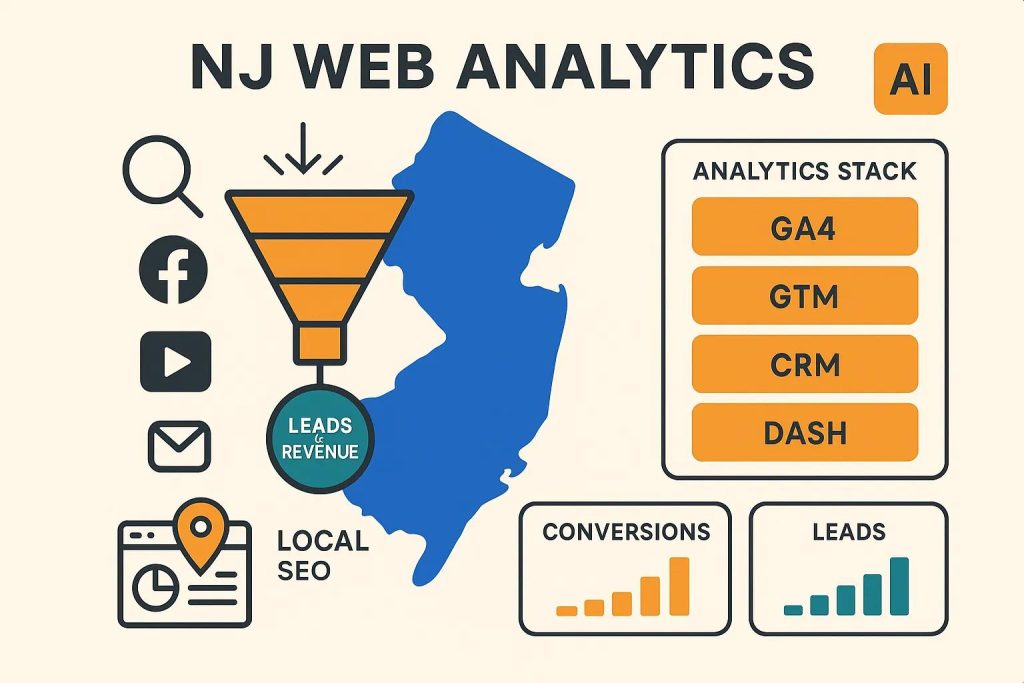
In practice, start with GA4 for event-driven insight, use GTM to deploy events and call-tracking pixels, and add a CRM to reconcile leads with closed revenue. GA4 handles sessions and events well, while GTM reduces implementation friction so marketers can iterate without constant developer support. CRM analytics ties online signals to appointments and sales so attribution reflects real business outcomes. Complexity varies: GA4 and GTM are achievable for in-house teams with some technical help, while CRM integrations often need configuration or partner support for advanced attribution.
A phased rollout — GA4 and GTM first, then call tracking, then CRM attribution — lowers risk and delivers early wins that fund automation and AI optimization later.
AI Support for Website Performance Insights
AI improves analytics by automating anomaly detection, predicting lead quality, and surfacing the highest-impact optimization opportunities faster than manual review. Models can analyze historical event sequences to predict which sessions are most likely to convert, enabling predictive lead scoring and smarter follow-up. AI-driven anomaly detection shortens time-to-action by flagging sudden drops in local impressions or spikes in form abandonment that need immediate fixes. Automated reports and plain-language summaries keep small teams informed without building complex dashboards.
Use AI responsibly: validate model outputs against actual outcomes and let predictions augment — not replace — human judgment so seasonality and local context remain central to decisions.
Using Website Performance Insights to Improve Lead Generation
Website performance insights improve decisions when teams test a change and review the outcome. First, track forms, calls and bookings consistently. Then connect those inquiries with sales results where practical. If a page receives visits but few qualified leads, examine the offer and contact path. Finally, compare a consistent period before and after each change, while noting other factors that may affect demand.
Intro: Use this mapping to link analytics metrics to concrete lead-generation choices and budget decisions.
| Metric / Model | What it Measures | How it impacts lead generation |
|---|---|---|
| Conversion Rate | Share of sessions that produce leads | Helps prioritize landing pages and traffic sources |
| Leads per Channel | Number of leads by source | Informs budget shifts toward high-performing channels |
| Lead Velocity | Rate at which leads arrive over time | Guides resource planning for follow-up teams |
| Attribution Model | How credit is assigned across touchpoints | Improves multi-channel budget allocation |
Once you map metrics to actions, set a regular cadence for experiments, measurement, and iterative budget reallocation to steadily improve both lead quantity and quality.
Local SEO analytics tactics to drive more NJ leads
Local SEO analytics centers on Google Business Profile signals, local keyword performance, and on-page location relevance to convert Map and organic visibility into leads. Track GBP metrics — impressions, views, calls — and tie them to landing pages with UTM parameters to see which listings actually produce appointments. Treat location pages separately and A/B test headlines, local schema markup, and prominent calls-to-action to raise conversions. Run citation audits and monitor reviews to keep NAP consistency and trust signals strong, which influences click-throughs and conversions.
These monitoring tactics let New Jersey businesses respond to shifting local intent and amplify the pages that consistently convert visitors into callers or bookings.
Multi-channel attribution models for New Jersey businesses
Attribution assigns credit for leads and is essential for smarter budget decisions across search, Maps, social, and paid channels. Small teams can start by comparing simple models — last click, linear, time decay — to understand how credit moves, then upgrade to data-driven attribution as data volume allows. For many NJ SMBs a blended approach works: use last-click for short-term campaign reporting, but evaluate multi-touch and data-driven models for strategic budget planning. Proper attribution needs consistent UTM tagging, CRM integration, and a conversion-value framework so each channel’s contribution to revenue is measurable.
Begin with practical setups that match your team’s capacity and adopt advanced attribution as measurement maturity grows.
Industry-specific analytics strategies for NJ contractors, law firms, HVAC, medical, and manufacturing
Analytics strategies should reflect each industry’s conversion behavior and regulatory or operational constraints. Contractors and HVAC firms depend on phone leads and seasonality; law firms and medical practices prioritize consult requests and appointments while staying privacy-conscious; manufacturers track quote requests and B2B qualification steps. Regardless of vertical, the goal is the same: instrument the unique conversion events, map them to CRM outcomes, and build dashboards that surface the most predictive revenue indicators. The table below lists industry-specific metrics and example KPI aims to help teams prioritize tracking and reporting.
Intro: This table shows the most relevant metrics per industry and example KPI aims to guide dashboard design and optimization.
| Industry | Top Metrics to Track | Example KPI aims |
|---|---|---|
| Contractors / HVAC | Calls, booked estimates, job source by campaign | Increase booked estimates by 25% in peak season |
| Law Firms | Consult requests, form completions, call duration | Raise qualified consults while maintaining lead quality |
| Medical Practices | Appointment bookings, no-show rate, referral source | Improve bookings and reduce no-show rates by 10% |
| Manufacturing | Quote requests, lead qualification stages | Shorten lead-to-quote cycle and increase quote conversions |
Using these industry checklists helps dashboards surface the metrics that map directly to business performance and support faster, domain-aware decisions.
Custom analytics approaches for NJ contractors and HVAC companies
Field-service businesses like contractors and HVAC teams benefit from tracking booking sources, appointment conversion rates, and seasonal campaign performance so scheduling and inventory align with demand. Implement call tracking with source attribution so you can see which search terms or ads produce phone leads that convert to jobs. Geo-targeted landing pages and service-area segmentation let teams measure performance by ZIP code and run targeted promotions where ROI is highest. Tracking scheduling funnels and lead-to-job close rates closes the loop between marketing spend and operational outcomes — critical for optimizing both ads and dispatch planning.
These domain-specific implementations reduce friction between leads and field operations, improving conversion rates and operational efficiency.
Web analytics best practices for NJ law firms and medical practices
Law firms and medical practices require careful lead qualification, appointment-scheduling tracking, and privacy-safe practices that avoid storing sensitive information in analytics tools. Track consultation requests and form completions using non-identifying event data and map outcomes in the CRM without putting protected health or legal details into analytics platforms. Emphasize trust signals on service pages, clear appointment CTAs, and simple contact paths to reduce friction and lift conversions. Use event-level data (click-to-call, confirmation pages) to measure effectiveness while keeping lead handling secure and compliant.
Following these practices preserves client trust and still gives you accurate measurement of which content and campaigns generate qualified consultations.
Evaluating Website Performance Insights Through Case Studies
Case studies turn claims into concrete outcomes by showing before/after metrics from analytics-driven interventions. Typical examples list baseline traffic and lead rates, the analytics and optimization steps taken (tooling, event tracking, attribution changes, AI insight), and the resulting lift in leads, conversion rate, and revenue. Showing timeframes and repeatable methods helps other New Jersey businesses judge whether similar gains are realistic. The sections below describe success narratives and ROI snapshots that reflect common results from focused analytics engagements.
Case evidence adds credibility to analytics recommendations and maps the path from measurement to profitable action.
Success stories: NJ small businesses using AI-enhanced analytics
Across industries, AI-enhanced analytics has produced measurable uplifts by highlighting high-impact issues and prioritizing experiments. In practice, AI anomaly detection uncovers sudden traffic-quality shifts that went unnoticed, while predictive lead scoring helps sales focus on the highest-intent contacts. These interventions often increase appointment rates, lower cost-per-qualified-lead, and speed lead-to-sale cycles by concentrating human effort where it matters. Sharing the metrics and steps taken makes these results repeatable for other New Jersey businesses pursuing similar improvements.
The repeatable sequence is simple: instrument, analyze (with AI where appropriate), act on prioritized opportunities, and measure the impact.
Measurable ROI from MarketMagnetix web analytics services
MarketMagnetix Media Group is a New Jersey-based digital agency focused on data-driven marketing for local businesses. Our analytics services include consulting and implementation, AI-enhanced optimization, and strategy sessions designed to improve visibility and lead generation for NJ small businesses across contractors, law firms, HVAC, medical practices, and manufacturers. By combining measurement best practices with AI insights and CRM integration, we help clients convert traffic into higher-quality leads and measurable revenue gains.
If your team values case-study evidence and a consultative approach, a focused strategy session can surface comparable ROI opportunities and deliver a prioritized implementation roadmap.
How to book a personalized web analytics strategy session in New Jersey
Booking a strategy session moves diagnostic findings into prioritized actions tailored to your goals. A productive session starts with discovery, a quick analytics audit, prioritized recommendations, and a roadmap with measurable milestones. Preparing in advance — granting analytics and CRM access, gathering recent campaign data, and clarifying primary KPIs — speeds the session and increases value. The subsections below outline the session agenda and a checklist to prepare your team for analytics optimization.
These preparation steps help ensure a strategy session delivers immediate, actionable next steps rather than vague suggestions.
What to expect in a web analytics strategy session with MarketMagnetix
Our sessions include discovery questions, a concise analytics audit, priority recommendations, and a follow-up plan with measurable actions. The agenda typically covers account access review, verification of key conversion points, a snapshot of attribution and reporting gaps, and a short list of prioritized fixes plus a roadmap for implementation and measurement. Deliverables usually include high-impact technical fixes, recommended tracking changes, and a timeline for AI optimization and CRM integration. To proceed, New Jersey businesses can schedule a session with MarketMagnetix to receive a tailored analytics roadmap and prioritized implementation plan.
This clear agenda sets expectations and makes it easy to evaluate the session’s impact on lead generation and visibility.
Preparing to Act on Website Performance Insights
Good preparation saves time and increases session effectiveness by letting the team validate hypotheses quickly and implement prioritized changes. Before the session, gather access to analytics accounts, a list of primary KPIs, recent campaign details, and contact information for stakeholders responsible for follow-up. Also collect recent monthly reports, sample leads, and CRM access or an export so online events can be tied to offline outcomes. Having these materials ready helps produce prioritized actions you can implement within weeks.
Being prepared shortens the path from insight to impact and speeds measurable lead-generation improvements.
Checklist to prepare for your strategy session:
- Provide analytics and tag manager account access to the consulting team.
- Compile primary KPIs and recent campaign performance summaries.
- Export recent CRM lead records or grant CRM access to link online leads to outcomes.
Frequently Asked Questions
1. How can small businesses in New Jersey ensure compliance with privacy regulations when using web analytics?
Follow applicable privacy rules like CCPA and GDPR by asking for consent before collecting personal data, publishing a clear privacy policy, and offering opt-out choices. Anonymize data where possible and confirm third-party analytics vendors meet compliance standards. Regular audits of data practices help maintain compliance and build customer trust.
2. What are the common challenges New Jersey businesses face when implementing web analytics?
Typical issues include limited technical know-how, difficulty integrating multiple data sources, and internal resistance to change. Small teams may struggle to pick tools that fit their needs and budget, and interpreting data correctly can be daunting. To overcome these barriers, consider professional consulting or targeted training to raise internal analytics capability.
3. How can businesses measure the effectiveness of their web analytics strategies over time?
Define clear KPIs tied to your goals — conversion rate, lead quality, and customer acquisition cost — and review them regularly to track performance trends and guide decisions. Use A/B testing to validate changes and set periodic analytics reviews to identify improvement opportunities and confirm the impact of optimizations.
Experience and Analytics Questions
4. What role does user experience play in web analytics for lead generation?
UX directly affects conversion rates: a smoother experience increases engagement and the likelihood of conversion. Analytics highlights UX issues through metrics like bounce rate and time on page. Use that data to improve navigation, content layout, and calls-to-action, which in turn boosts lead generation and customer satisfaction.
5. How can New Jersey businesses leverage AI in their web analytics efforts?
AI can analyze large datasets to reveal patterns and insights that are hard to spot manually. Use machine learning for anomaly detection, predictive analytics, and customer segmentation to prioritize work and forecast trends. AI-assisted lead scoring and automated reporting free your team to focus on strategy and follow-up that drive ROI.
6. What are the best practices for setting up a web analytics dashboard?
Start with clear objectives and select a handful of KPIs that align with business goals. Choose a dashboard platform that’s easy to read and customize for real-time trends. Keep the layout focused on decision-making metrics, update it as priorities shift, and train team members to interpret the data accurately.
7. How can businesses in New Jersey use web analytics to enhance their local SEO efforts?
Track local-search performance — impressions and clicks from Google Business Profile and Maps — and map those signals to landing pages with UTM parameters to see which listings yield appointments. Analyze which keywords drive conversions and A/B test page elements like CTAs and local schema. These steps improve local rankings and increase lead generation from nearby customers.
For further guidance, see the Web Vitals documentation. Also explore our guide on GA4 Implementation Guide: Tracking, Key Events and QA.


