
Drive Manufacturing Performance with Data-Driven Analytics
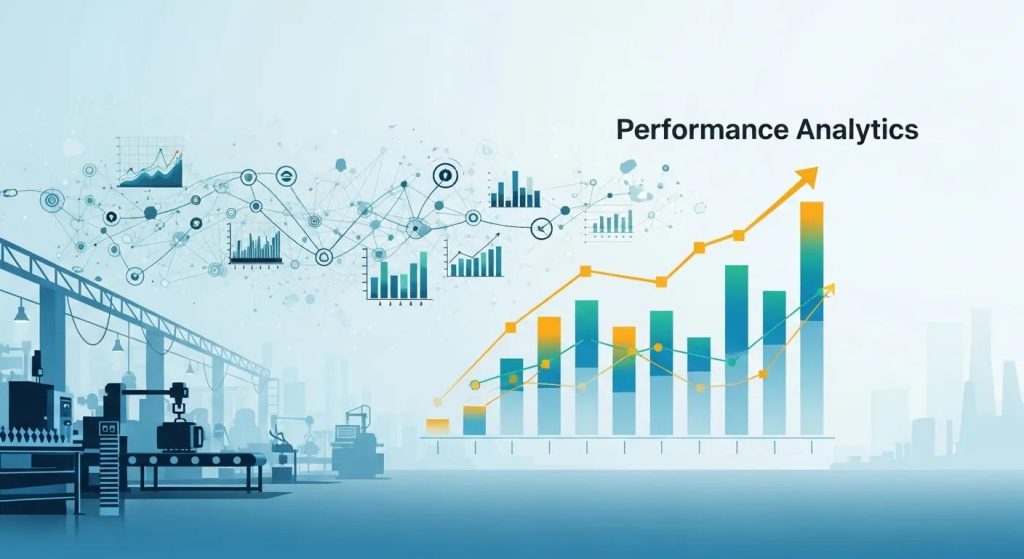
Performance analytics bring together production telemetry, machine signals, and business records to reveal where plants lose time, parts, and margin — then convert those signals into measurable efficiency gains and growth. Read on to see how these tools increase uptime, raise product quality, cut operating costs, and feed higher-value leads into your commercial pipeline. We cover core concepts — IIoT sensors, predictive maintenance models, live dashboards, and AI-driven optimization — and give practical steps for turning operational signals into qualified RFQs and shorter sales cycles. You’ll also get measurement frameworks for marketing ROI, the dashboards and KPIs manufacturers actually use, predictive-analytics use-cases that unlock aftermarket revenue, and the 2025 trends (AI, cloud consolidation, workflow automation) that accelerate results. Expect actionable checklists, comparative tables, and campaign examples so your team can prioritize the highest-impact moves.
Bringing together diverse information sources across manufacturing operations remains one of the industry’s toughest, most persistent challenges.
Crucial Information Integration in Manufacturing
Coordinating the information needed for cell autonomy and for manufacturing applications that both produce and consume that information has become essential.
Manufacturing integration, 1995
What Are Manufacturing Performance Analytics and Their Core Benefits?
Manufacturing performance analytics ingest IIoT sensor feeds, machine telemetry, and production records into analytics stacks that expose inefficiencies and opportunities. They turn raw signals into contextual KPIs and predictive scores operations and commercial teams can act on. By automating anomaly detection, prioritizing maintenance, and informing capacity plans, these systems boost throughput and product quality while reducing cost. Measurable outcomes include less scrap, fewer unplanned stops, better on-time delivery, and clearer procurement differentiation where reliability matters. Below is a concise list of the core benefits and why each one matters to manufacturers.
These platforms succeed when they stitch varied data sources into a single, trusted operational picture.
Big Data Integration for Intelligent Manufacturing
Manufacturing data integration and sharing (MDIS) is a key enabler of data-driven intelligent manufacturing. Preconditions include modeling product life cycles, defining data-acquisition strategies aligned to those scenarios, balancing stakeholder and environmental impacts, and standardizing data services. This discussion covers integration from equipment and cell level up through plant and enterprise, and then to the cloud.
Systematic method for big manufacturing data integration and sharing, 2018
Manufacturing performance analytics produce these primary operational and commercial benefits:
- Efficiency gains: Smoother workflows and shorter cycle times increase throughput without adding capacity.
- Quality improvements: Early defect detection reduces scrap and rework, improving yield and customer satisfaction.
- Cost reduction: Predictive maintenance and smarter scheduling cut labor and spare-part costs tied to breakdowns.
- Higher uptime: Condition monitoring and proactive fixes keep lines running and orders on schedule.
- Smarter capacity planning: Data-driven forecasts make quotes more accurate and fulfillment faster, supporting sales growth.
Those operational improvements translate directly into marketing-worthy USPs — predictable lead times, consistent quality, and dependable delivery — the attributes procurement teams prize. Turning technical benefits into buyer-focused messages is the bridge from operations to marketing, which we cover next.
How Do Data Analytics Improve Manufacturing Efficiency and Quality?
Analytics raise efficiency and quality by spotting anomalies, enabling root-cause analysis, and closing optimization loops between sensors and control systems. Anomaly detection flags unusual thermal, vibration, or throughput patterns so technicians can intervene before defects escalate. Root-cause tools link anomalies back to process parameters so fixes address the true cause. Process optimization uses historical and live data to refine setpoints and reduce cycle variability, lowering scrap and shortening cycle time. These methods commonly deliver double-digit gains on targeted lines, and the same evidence used to fix production serves as proof points in technical marketing to shorten sales cycles.
What Role Does Predictive Maintenance Play in Reducing Downtime?
Predictive maintenance converts sensor-derived features and models into forecasts of equipment wear so teams can schedule service before failures occur. Moving from reactive repairs to condition-based maintenance turns noisy telemetry into clear maintenance triggers that protect throughput and extend asset life. Models typically use time-series signals — vibration, temperature, runtime trends — plus historical failure labels to predict remaining useful life and service windows. The result: fewer emergency repairs, higher line availability, and operational KPIs marketing teams can highlight when selling uptime and reliability.
How Performance Analytics Drives Targeted Manufacturing Marketing
Manufacturers can turn operational signals into segmentation, messaging, and channel choices by mapping production insights to buyer priorities and purchase triggers. Start by identifying signals that indicate capacity, reliability, or consistency, then segment accounts that value those attributes — for example, OEMs requiring JIT supply or processors with tight tolerances. Analytics-informed campaigns typically combine account-based marketing, technical PPC, and content that showcases proof-of-performance dashboards and before/after metrics. Below is a mapping table that shows how common operational signals translate into practical campaign tactics your marketing team can run.
Intro to mapping table: This table links common operational signals to the buyer insight they convey and the campaign tactic that best highlights that advantage.
| Operational Signal | Insight for Buyers | Campaign Tactic |
|---|---|---|
| Uptime rate / MTBF | Reliability and lower supply risk | Account-based ads and case studies highlighting uptime guarantees |
| Scrap rate / yield | Consistent quality and lower rework costs | Technical whitepapers and RFQ landing pages that publish quality metrics |
| Available capacity | Ability to take large orders quickly | Targeted PPC promoting short lead times for specific part families |
| Predictive maintenance alerts | Lower lifecycle cost and service readiness | Service-contract offers and aftermarket campaigns |
This mapping helps marketing craft messages that match procurement priorities and technical buyers. Once you identify which signals matter to target segments, the next step is structuring campaigns that convert those operational truths into qualified RFQs.
Practical campaign steps to consider:
- Identify signals: Catalog telemetry and KPIs that demonstrate commercial value.
- Segment audiences: Group prospects by the operational pain points those signals address.
- Craft messaging: Use proof-backed claims and dashboards to support technical assertions.
- Select channels: Use ABM, PPC, or trade outlets to reach engineering and procurement teams.
Those steps create a repeatable data-to-demand workflow. For teams that need execution help, specialized services can operationalize these tactics. MarketMagnetix Media Group offers targeted execution — Industrial SEO, Google Ads for manufacturers, AI optimization, and Real-Time ROI Dashboards — that pair with analytics-to-marketing workflows to lift lead quality and campaign performance. If you want a practical starting point, book an audit to map your top signals to priority campaigns.
How Does Data-Driven Marketing Generate Qualified Leads in Manufacturing?
Data-driven marketing focuses outreach on accounts whose operational profiles show immediate need or strong fit, then uses proof-based content to reduce evaluation friction. Signals such as open capacity windows, elevated scrap at competitor sites, or predictive alerts for aftermarket services reveal buying windows or upsell moments. Marketing targets those accounts with technical case studies, RFQ-focused landing pages, and demos. High-conversion channels for technical audiences include targeted LinkedIn outreach to engineers and procurement, search ads for specific part or service queries, and gated whitepapers that capture RFQ intent. The funnel looks like: signal → prioritized list → tailored content → RFQ volume, aligning commercial outreach to operational reality.
What Are Effective Strategies to Communicate Data-Driven Manufacturing Advantages?
Translate technical metrics into procurement language and concise visual proof. Use compact dashboards, before/after metric summaries, and downloadable technical dossiers that show uptime, yield, and cost-per-part improvements in procurement-friendly formats. Headline templates like “X% fewer rejects in 90 days” or “Y% uptime improvement for continuous lines” turn technical data into clear ROI claims. Effective distribution tactics include gated technical content for target accounts, demo dashboards embedded in proposals, and post-RFQ proof packages shared during bid evaluation.
How to Measure and Optimize Marketing ROI Using Performance Analytics Tools?
To measure and optimize marketing ROI in manufacturing, tie marketing touchpoints to qualified RFQs and downstream purchase value through a structured attribution and optimization loop. Begin by defining the conversion events you care about — RFQ submissions, technical downloads, demo requests — and build dashboards that show conversion rates, cost per RFQ, and PO attribution. Use first-touch, multi-touch, or outcome-based attribution models that incorporate operational feedback (order dates, PO value) to calculate return on marketing investment. The checklist below outlines a practical framework for measurement and continuous optimization.
Use this step-by-step checklist to measure and optimize ROI:
- Define conversions: Agree on RFQ, demo, and PO-attribution events to track.
- Instrument tracking: Ensure campaigns, landing pages, and CRM capture both touchpoints and operational signals.
- Attribute outcomes: Map RFQs to downstream POs using your chosen attribution model.
- Optimize continuously: Use dashboards to spot underperforming channels and reallocate budget to higher-quality RFQ sources.
Dashboards that surface cost per RFQ, conversion velocity, and PO-attributed revenue let teams close the loop between marketing spend and operational outcomes. Below is a comparison table of common dashboard metrics, what they measure, and how marketing uses them to optimize campaigns.
Intro to dashboard EAV table: The table compares common dashboard metrics, their operational meaning, and their marketing application for continuous optimization.
| Metric / Dashboard Widget | What It Measures | Marketing Use / Business Impact |
|---|---|---|
| RFQ volume by campaign | Number of qualified requests sourced by each campaign | Prioritize channels with the best RFQ yield to lower CAC |
| Cost per RFQ | Total spend divided by qualified RFQs | Reallocate budget toward cost-efficient campaigns |
| Conversion velocity | Time from first touch to RFQ submission | Tune creative and cadence to shorten the sales cycle |
| PO attribution rate | Share of RFQs that convert to purchase orders | Measure LTV and calculate channel-level marketing ROI |
These metrics tie marketing activity to commercial outcomes and guide optimization. Visualizing and alerting on these widgets enables quick strategy shifts when a channel underperforms or when an operational event opens a buying window.
MarketMagnetix’s Real-Time ROI Dashboards show how to combine campaign analytics with qualified RFQ tracking to make marketing ROI visible and actionable in near real time. Reported client metrics demonstrate average lifts in qualified RFQs and strong ROI when marketing is aligned with operational analytics.
Which Real-Time Dashboards and Metrics Track Manufacturing Marketing Success?
Real-time dashboards for manufacturing marketing should highlight RFQ volume, cost per RFQ, conversion by campaign, and PO attribution rate so teams see both demand generation and downstream value. Widgets that combine operational KPIs — capacity utilization or lead time — with marketing performance provide context to prioritize prospects most likely to convert. Benchmarks and alert thresholds speed decisions: flag when cost per RFQ exceeds targets or when RFQ velocity drops for a high-value account. These dashboards enable tactical budget moves and strategic planning that favor segments with the best LTV-to-CAC ratios.
How Does AI Optimization Enhance Marketing Campaign Performance?
AI optimization improves campaigns by scoring leads for predicted quality, automating bids toward higher-value prospects, and personalizing creative to account signals and engagement. Predictive scoring models map signals such as content engagement, firmographic fit, and production telemetry to a purchase likelihood that feeds ad platforms and sales queues. Automated bidding prioritizes spend for segments with stronger predicted RFQ-to-PO conversion, boosting ROAS. Creative personalization delivers dynamic content that highlights the operational benefit most relevant to each segment — uptime, quality, or capacity — increasing conversions and shortening evaluation cycles.
What Are Key Applications of Predictive Analytics for Manufacturing Lead Generation?
Predictive analytics enable several high-impact lead-generation use-cases by turning operational signals into sales triggers and service offers. Examples include converting predictive maintenance alerts into service-contract opportunities, using demand forecasts to time outreach before capacity shortfalls, and predicting aftermarket churn to trigger renewal campaigns. Each use-case relies on different signal sets — sensor patterns for maintenance, order trends for demand forecasting, contract usage for churn — and delivers measurable outcomes like higher service attach rates and shorter sales cycles. The table below compares use-cases, required signals, and likely marketing outcomes.
Intro to predictive-use EAV table: This comparison clarifies which data signals feed each predictive use-case and the expected commercial benefit.
| Use-case | Required Data Signals | Expected Marketing / Sales Outcome |
|---|---|---|
| Predictive maintenance leads | Vibration, temperature, runtime, failure history | Targeted service offers and higher service-attach rates |
| Demand-forecast outreach | Order history, seasonality, inventory levels | Timely bids and improved quote-to-order conversion |
| Aftermarket churn prediction | Contract renewals, service usage, complaint logs | Proactive renewals and higher retention revenue |
These applications show how predictive models turn operational data into marketing-ready triggers and outreach lists. When implemented correctly, predictive analytics produce actionable lists sales and marketing can act on quickly to capture revenue.
Priority predictive analytics applications for marketing and product teams:
- Service-selling from maintenance alerts: Turn impending failures into contract offers.
- Demand-driven prospecting: Reach accounts before capacity shortages or demand spikes.
- Customer-retention campaigns: Use churn scores to schedule renewal offers and technical check-ins.
How Does Predictive Maintenance Support Marketing of Maintenance Services?
Predictive maintenance creates marketing opportunities by generating timely alerts that indicate service need, enabling tailored offers for service contracts or spare-part bundles. A predictive alert can trigger a workflow that delivers a customized service proposal, pricing, and SLA options to the account most at risk of downtime. Key KPIs include service attach rate, average contract value, and renewal rate — metrics marketing can track alongside operational outcomes to prove value. This converts technical alerts into contracted revenue and builds a scalable recurring-revenue channel for product and marketing teams.
How Can Data Insights Shorten Manufacturing Sales Cycles?
Data insights shorten sales cycles by providing validated proof-of-performance early in evaluation, removing repetitive validation steps for engineering teams. Sales can include compact dashboards, historical yield comparisons, and predictive uptime projections in proposals so procurement can verify claims without lengthy extra testing. Sharing targeted metrics during RFP responses builds credibility and helps procurement fast-track approvals, reducing RFQ-to-PO timelines. Using data as a sales-enablement tool also shifts conversations from price to operational value and total cost of ownership.
What Are the Latest Industry Trends in Manufacturing Analytics for 2025 and Beyond?
Heading into 2025 and beyond, manufacturing analytics center on AI/ML, cloud consolidation, and workflow automation that connects operations data directly to commercial systems for real-time decisions. AI sharpens predictions and enables personalized marketing by scoring lead quality and recommending offers. Cloud consolidation aggregates telemetry across sites for benchmarking and scale, while workflow automation ensures signals instantly trigger campaign or sales actions. These trends shorten the time from insight to action and raise buyer expectations for vendor transparency and proof.
Three dominant trends and what they mean for manufacturers:
- AI/ML-driven prediction: Earlier, more accurate maintenance and demand forecasts.
- Cloud consolidation: Cross-site aggregation enables benchmarking and centralized triggers.
- Workflow automation: Automated triggers connect analytics outputs to CRM and campaign systems for immediate outreach.
Adopting these trends lets manufacturers turn near-real-time operational events into commercial opportunities, but success requires robust data pipelines and governance — a shared responsibility between operations and marketing.
How Are AI and Machine Learning Transforming Smart Factories?
AI and ML automate anomaly detection, suggest corrective actions, and enable prescriptive maintenance by learning normal equipment behavior and flagging deviations with severity scores. These tools reduce manual triage, speed root-cause work, and recommend fixes based on past outcomes, boosting productivity and cutting downtime. For marketing, AI-derived insights improve lead scoring and personalization because models estimate an account’s commercial value from its operational profile. The result is a virtuous cycle: smarter factories generate cleaner signals that lead to smarter marketing and sales.
Why Is Cloud Adoption and Workflow Automation Critical for Manufacturers?
Cloud adoption centralizes disparate plant data and lets analytics teams build cross-site models that outperform siloed approaches. Workflow automation ties analytics outputs to CRM and campaign tools so a predictive alert can create a sales task, send a targeted email, or reallocate paid spend toward affected regions. Together, cloud and automation lower IT overhead, speed insight delivery, and let marketing act on the freshest signals — increasing campaign relevance and the chance of converting RFQs into higher-value orders.
How Does MarketMagnetix Media Group Support Manufacturers with Performance Analytics Marketing?
MarketMagnetix Media Group combines manufacturing-aware marketing services with real-time dashboards and AI optimization to generate qualified RFQs and measurable ROI. The firm’s service mix — reported in industry listings — includes Industrial SEO, Google Ads for manufacturers, Real-Time ROI Dashboards, AI optimization, chatbot development, local listings, social ads, and digital asset leasing. Their process starts with an audit, maps analytics signals into campaign targeting, runs multi-channel campaigns, and surfaces results in dashboards so teams can optimize continuously. Industry summaries report meaningful lifts in RFQs and marketing ROI when these services are paired with operational analytics.
The typical engagement process follows these phases:
- Audit and signal mapping: Review existing telemetry and prioritize signals that map to market opportunities.
- Integration and dashboarding: Build dashboards that combine marketing and operational KPIs for real-time visibility.
- Campaign execution: Run targeted SEO and paid programs using AI optimization and industry-focused creative.
- Continuous optimization: Use dashboard insights to refine messaging, bids, and account prioritization.
MarketMagnetix’s reported client metrics include an average 287% increase in qualified RFQs and a 4.2x return on marketing investment; one referenced case cites a 425% increase in qualified leads and $3.2M in new contracts. Those figures illustrate how linking operational analytics to marketing execution creates measurable commercial value. For a practical first step, request an analytics-to-marketing audit to map your signals and low-friction campaign opportunities.
What Specialized Services Does MarketMagnetix Offer for Manufacturing Lead Generation?
MarketMagnetix provides services tailored to manufacturing lead generation, each aligned with analytics-driven outcomes: Industrial SEO for organic visibility to technical buyers, Google Ads for Manufacturers to capture RFQ intent, Real-Time ROI Dashboards to measure campaign-to-PO performance, AI optimization to surface high-quality leads, and chatbots to capture and qualify prospects instantly. They also offer local map listings and social ads to reach regional buyers and digital asset leasing to accelerate content distribution. Each service turns operational proof — uptime, yield, capacity — into targeted campaigns that increase RFQ volume and quality.
What Are Real Client Success Stories Demonstrating Measurable ROI?
Industry summaries highlight client examples where analytics insights plus targeted marketing produced strong growth: aggregated reporting shows an average client uplift of 287% in qualified RFQs and a 4.2x marketing ROI, while a referenced case reported a 425% rise in qualified leads and $3.2M in new contracts. These examples demonstrate the impact of using operational proof as core campaign assets and making ROI visible in dashboards. For manufacturers evaluating investment, these reported results provide a data-driven rationale to pilot an analytics-to-marketing program and track the same metrics that delivered results for others.
Frequently Asked Questions
What types of data sources are essential for effective manufacturing performance analytics?
Effective manufacturing analytics rely on IIoT sensors, PLC and machine telemetry, and production records. Together they offer real-time visibility into equipment health, process performance, and output quality. Integrating historical and live data lets teams spot trends, predict failures, and optimize processes — enabling decisions that boost productivity and cut costs.
How can manufacturers ensure data security when using performance analytics tools?
Data security is essential. Manufacturers should use layered defenses: encrypt data in transit and at rest, enforce role-based access controls, and run regular audits. Choose cloud providers with strong security certifications and enforce clear data governance policies. Train staff on secure handling practices and keep software patched to reduce vulnerabilities.
What challenges do manufacturers face when integrating performance analytics into their operations?
Common challenges include data silos, cultural resistance, and integration complexity. Disparate systems make it hard to build a single source of truth, and teams may be wary of new workflows. Overcoming these obstacles requires leadership buy-in, a clear change-management plan, and targeted training so teams adopt analytics without disrupting operations.
How can predictive analytics improve customer satisfaction in manufacturing?
Predictive analytics improve customer satisfaction by enabling proactive service and more reliable delivery. Better forecasts help optimize inventory and reduce lead times, while predictive maintenance prevents outages that affect shipments. The result is more consistent quality and on-time performance, which builds trust and repeat business.
What role does employee training play in maximizing the benefits of performance analytics?
Training is critical. Teams need data literacy and tool-specific skills to interpret insights and act on them. Training programs should cover analytics fundamentals, how dashboards map to decisions, and hands-on use of the tools. A culture of continuous learning helps embed analytics into daily operations and realize measurable benefits.
How can manufacturers measure the success of their performance analytics initiatives?
Measure success with KPIs tied to business goals: production efficiency, downtime reduction, yield improvement, and cost savings. Also track commercial metrics such as RFQ volume, PO attribution, and marketing ROI when analytics drive demand. Regular reviews and adjustments keep the program aligned with changing business priorities.