

MarketMagnetix vs WebFX: Compare Agency Fit for Small Businesses
MarketMagnetix vs WebFX is a choice about fit, scope, and how you will measure results. Compare the proposed services, reporting, and costs against your business goals. This guide gives you questions to use when reviewing each agency.
MarketMagnetix Media Group positions itself as a lead generation and information hub focused on accelerating SMB growth through a named “Digital Dominance System” that bundles AI SEO, web design, local map listing management, chatbot development, social ads, Google PPC, and digital asset leasing. This concise mission statement clarifies MarketMagnetix’s SMB orientation and niche industry focus while the remainder of the article emphasizes objective comparison criteria. The subsequent sections break down core services, pricing models, target clients, technology stacks, client experience, and measurable outcomes so readers can weigh trade-offs side-by-side. Throughout, the comparison stresses practical decision triggers for small businesses evaluating either partner.
What Are the Core Services Offered by MarketMagnetix and WebFX?
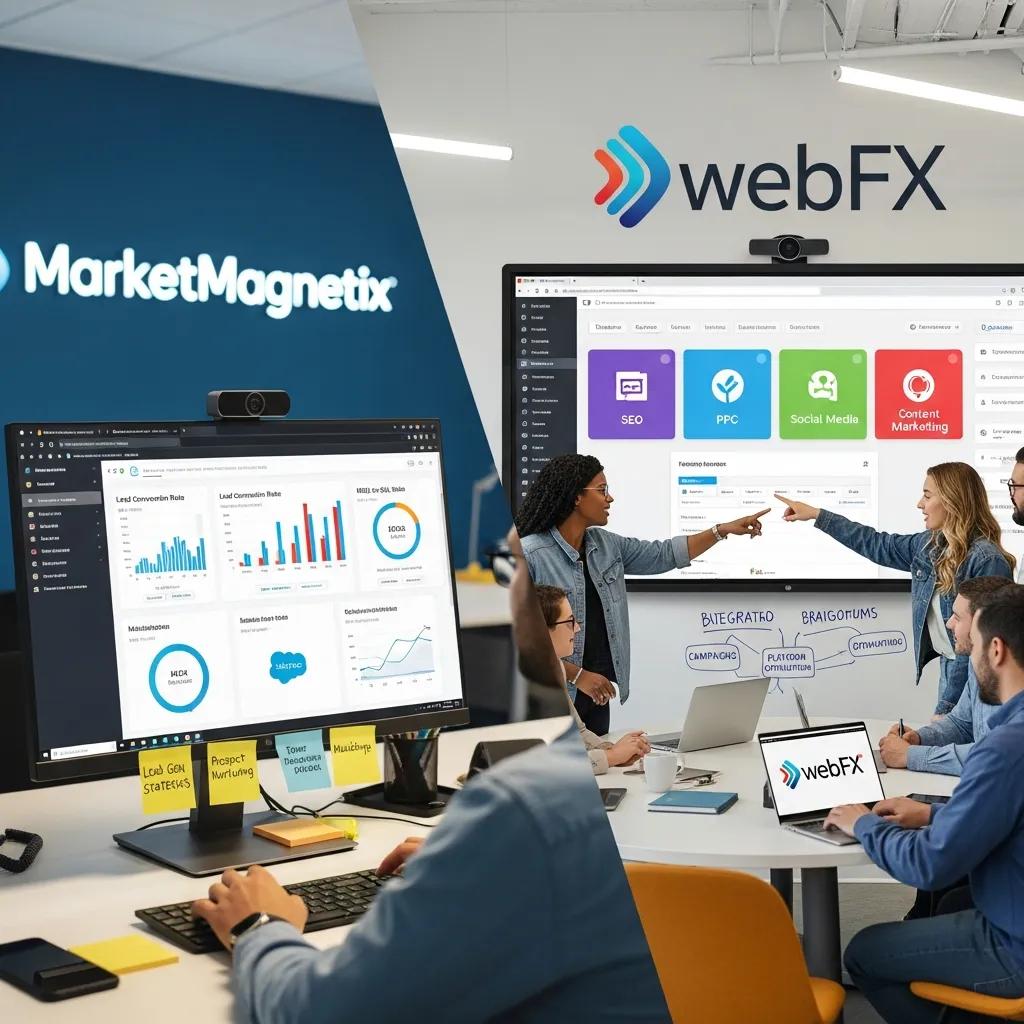
Core services describe the primary capabilities each agency deploys, why those services work, and the direct value they deliver to small businesses seeking growth. At a high level, both MarketMagnetix and WebFX provide SEO, paid media, web design, local listing management, and analytics, but they differ in packaging and emphasis. Understanding the content of each service and the outcome it targets helps SMBs match investments to expected business results. The following table breaks down the most common service categories, what they include, and the primary benefit for small-business clients.
The table below summarizes core service components and typical outcomes for small-business marketing.
| Service | What it includes | Primary benefit / outcome |
|---|---|---|
| SEO (AI-enabled) | On-page optimization, keyword strategy, local citations, content optimization | Higher organic visibility and qualified local traffic |
| Paid Media (PPC & Social) | Campaign setup, audience targeting, ad creative, conversion tracking | Faster lead generation with measurable CPL control |
| Web Design & CRO | Responsive design, conversion-focused layouts, performance optimization | Better conversion rates and improved user trust |
| Local Map Listing | GBP management, citation consistency, review monitoring | Improved local search visibility and more inbound calls |
| Chatbot & Automation | Lead capture flows, automated qualification, appointment booking | Faster lead qualification and reduced response times |
| Digital Asset Leasing | Reusable content assets, syndicated listings, creative templates | Scalable marketing assets that shorten campaign launch time |
This comparison clarifies which services drive traffic, which convert visitors, and which automate lead handling. Understanding these building blocks sets up the next section, which explains how MarketMagnetix’s branded system assembles these components for SMBs.
How Does MarketMagnetix's Digital Dominance System Enhance Small Business Marketing?
MarketMagnetix’s Digital Dominance System is a bundled approach that integrates AI SEO, web design, local map listing management, chatbot development, social advertising, Google PPC, and digital asset leasing to create predictable lead flows. The mechanism works by aligning on-page SEO and local listings to capture organic intent, while paid campaigns and social ads provide immediate visibility and fill lead gaps during ramp-up. Chatbots and automation streamline qualification and appointment booking so lead volume converts into scheduled opportunities with less manual follow-up. For niche sectors like manufacturers, law firms, HVAC, medical practices, and contractors, this system layers vertical-specific messaging and asset templates that shorten time-to-lead and improve lead quality.
MarketMagnetix packages these capabilities in a coordinated workflow: initial audit → technical SEO and local cleanup → landing page & CRO work → paid media activation → chatbot-enabled lead routing. This sequencing reduces wasted ad spend and accelerates measurable outcomes, particularly for small businesses with limited internal marketing resources. The value proposition emphasizes speed, repeatability, and niche tailoring, which matters to owners seeking immediate pipeline impact while building longer-term organic channels.
What Comprehensive Solutions Does WebFX Provide Across Industries?
WebFX offers a broad suite of services and a platform-oriented approach—often positioned around a comprehensive revenue platform—to serve clients across multiple industries with scalable processes. The core mechanism is centralizing data and automation so campaigns, SEO efforts, paid media, and content operate from the same analytics and optimization rules. This creates consistent measurement across channels and enables cross-channel attribution, which is valuable for larger SMBs or multi-location businesses that require unified reporting and governance.
Because WebFX emphasizes platformization, the practical benefit for clients is scalability: multi-location rollouts, complex attribution models, and large-scale content programs are easier to manage in a centralized environment. However, platform-driven solutions can be more process-heavy and might require more upfront scoping for small businesses that prefer faster, more tailored implementations. Understanding these trade-offs helps businesses choose between nimble, niche-centric approaches and broader platform scale.
How to Compare MarketMagnetix and WebFX Proposals
Pricing and packaging determine how accessible services are for small businesses and how transparent costs and commitments will be. MarketMagnetix is positioned toward SMB transparency and packaged bundling, whereas WebFX commonly relies on custom proposals and scoped engagements that reflect enterprise-level complexity. The following table compares pricing model attributes to surface how each approach maps to small-business budgets and decision criteria.
| Provider type | Pricing approach | Example value / implication |
|---|---|---|
| MarketMagnetix Media Group | SMB-focused, transparent packages and bundled services | Easier budgeting and clearer deliverables for small businesses |
| WebFX (platform-based) | Custom pricing via scoped proposals | Flexible but requires detailed scoping; better for larger budgets |
| Typical SMB-focused agencies | Tiered packages with optional add-ons | Predictable monthly costs and faster onboarding |
This table highlights that transparent packages help SMBs plan cash flow, while custom proposals can deliver tailored solutions at the cost of more upfront time and complexity. The next paragraphs explain what SMBs should expect from each approach when reviewing proposals.
What Are MarketMagnetix's Transparent Pricing Models for SMBs?
MarketMagnetix’s pricing approach is described as aligned with small-business budgets by packaging complementary services into coordinated systems rather than selling only discrete tasks. The mechanism emphasizes visible deliverables and clear scopes so owners can see which activities drive leads and when. For SMBs, the benefit is predictable monthly costs, easier ROI forecasting, and reduced vendor management because related services are bundled into a unified workflow.
When evaluating any transparent package, small-business leaders should request breakdowns for scope, deliverables, KPIs, and campaign termination terms. Those questions reveal whether a package contains meaningful optimization work versus one-time setup tasks. Clarity on expected lead volume, cost-per-lead ranges (if available), and reporting cadence is crucial to avoid surprises during the engagement.
What Should a Small Business Ask WebFX About Pricing?
WebFX typically operates with scoped proposals that are tailored to client scale, objectives, and technical needs, which enables more customized solutions but introduces variability in cost structure. The mechanism for custom pricing starts with discovery, technical audit, and backlog definition, followed by a proposal that maps work to outcomes; this benefits clients who need bespoke integrations, multi-location coordination, or advanced attribution. For smaller firms, the trade-off is that custom proposals can extend sales cycles and require more time to validate ROI assumptions.
Small-business clients should weigh the benefits of bespoke solutions against the administrative overhead and ensure proposals include clear milestones, delivery timelines, and clauses for performance review. If speed-to-market and predictable monthly spend are priorities, SMBs might prefer a packaged model; if complex data integrations or enterprise-style reporting are required, a customized approach can be worth the investment.
Who Is Best Suited for MarketMagnetix vs WebFX Services?
Matching agency profiles to business types requires understanding each agency’s strengths and which client attributes align with those strengths. MarketMagnetix targets small businesses and service professionals that benefit from niche expertise and an integrated lead-generation system, while WebFX suits larger SMBs or multi-location brands that prioritize platform-driven scale and centralized reporting.
This buyer-persona mapping helps owners decide which trade-offs—speed and niche alignment versus scale and platform control—matter most for their next growth phase. The next paragraphs provide specific SMB niche examples and practical signals to look for during vendor selection.
Which Small Business Owners Benefit Most from MarketMagnetix's Niche Expertise?
Small businesses in verticals like manufacturers, law firms, HVAC services, medical practices, and contractors often benefit from MarketMagnetix’s industry-focused playbooks because domain knowledge shortens time-to-lead and improves lead relevance. The mechanism is sector-specific messaging, targeted local SEO, and asset templates that reflect buyer intent in each niche, which reduces creative iteration and accelerates campaign performance. The practical benefit is higher-quality inbound leads and faster campaign ramp-up, particularly for owners who need measurable pipeline growth quickly.
Owners should look for case examples, vertical playbooks, and sample asset libraries when evaluating niche-focused agencies, and they should ask how the agency adapts messaging to local markets. For businesses prioritizing speed, predictable budgets, and industry-specific funnels, a niche-focused partner like MarketMagnetix aligns closely with those needs.
What Types of Businesses Are Ideal Clients for WebFX?
WebFX is typically a fit for larger small-to-mid-sized businesses, enterprises, or multi-location brands that need centralized campaign management, advanced attribution, and the ability to scale programs across many markets. The mechanism is a platform-based operating model that consolidates analytics, campaign rules, and reporting across channels, producing consistent insights at scale. The benefit for these clients is efficiency in managing many campaigns and coherent measurement frameworks that support larger marketing investments.
Before choosing a platform-driven agency, SMBs should assess internal readiness for process-heavy implementations, data infrastructure requirements, and whether the scale justifies the upfront scoping effort. Businesses with complex customer journeys, multiple locations, or enterprise-style governance will often gain the most from a platform-centered approach.
What Are the Key Technology and AI Integrations of MarketMagnetix and WebFX?
Technology and AI integrations determine how quickly campaigns iterate and how effectively automation improves lead quality. MarketMagnetix emphasizes AI-enabled SEO and chatbots within its Digital Dominance System, while WebFX markets a revenue platform (commonly referenced as RevenueCloudFX) that centralizes data and automations.
The rapid evolution of AI tools is fundamentally changing the landscape of search engine optimization, making it more advanced and targeted than ever before.
AI Tools for Advanced Search Engine Optimization
Search Engine Optimization is the process used in online Marketing to manage and regulate traffic on websites by using command of Algorithm created by programmers. Although Search Engine Optimization itself is the part of Artificial Intelligence but more specific A I tools enhanced the process of Optimization of Search Engines as well as Search Engine A I applications like Bing’s Chat GPT integration, Google SGE, Perplexity etc. enhances and make Search Engine Optimization practice advance.
Search Engine Optimization with Artificial Intelligence a Paradigm for Targeted Marketing, 2024
Below is a list of technology and AI features that commonly differentiate modern marketing providers:
- AI-driven on-page SEO automation that identifies content gaps and suggests optimizations.
- Chatbot development for lead capture, qualification, and appointment booking with automated routing.
- Centralized analytics platforms that enable cross-channel attribution and revenue visibility.
- Digital asset libraries and leasing models that speed up campaign launches across markets.
These technologies reduce manual work, increase iteration speed, and improve lead qualification. The next sections examine how MarketMagnetix applies AI tactically and how platformization influences WebFX’s offerings.
How Does MarketMagnetix Leverage AI for SEO and Chatbot Development?
MarketMagnetix deploys AI to accelerate on-page SEO optimization loops and to design chatbots that capture and qualify leads automatically, reducing manual optimization cycles. The mechanism for AI SEO is continuous content and metadata refinement driven by performance signals and intent modeling, which shortens the time between content publication and ranking improvements. For chatbots, the AI-enabled flows route qualified leads to the right human touchpoint or calendar slot, increasing conversion rates and reducing missed opportunities.
The strategic application of AI in SEO and digital marketing is increasingly recognized as a critical factor for enhancing market competitiveness, particularly in dynamic e-commerce environments.
AI-Powered SEO & Digital Marketing for Market Competitiveness
This study systematically investigates how artificial intelligence (AI) enhances market competitiveness through its application in search engine optimization (SEO) and digital marketing strategies within e-commerce environments. In an increasingly saturated and algorithm-driven digital marketplace, firms are under continuous pressure to improve visibility, personalization, and customer engagement. The findings reveal that AI technologies—such as machine learning, natural language processing, robotic process automation, and predictive analytics—are instrumental in transforming traditional marketing workflows across the entire digital funnel.
Enhancing Market Competitiveness Through AI-Powered SEO And Digital Marketing Strategies In E-Commerce, R Hasan, 2025
For SMBs, the practical benefits are faster optimization cycles and improved lead qualification without adding headcount. Businesses should examine the specific AI workflows, transparency of recommendations, and control over messaging to ensure the technology supports brand voice and compliance needs.
What Is WebFX's RevenueCloudFX Platform and Its Impact on Marketing?
RevenueCloudFX (as commonly referenced in platform discussions) centralizes marketing and sales data to automate attribution, reporting, and campaign optimization across channels, which enables data-driven scaling of revenue programs. The platform mechanism connects ad spend, SEO performance, and CRM outcomes so teams can evaluate revenue impact rather than isolated metrics. The primary benefit is a unified view of customer journeys and automated rules that reallocate budget toward high-performing channels.
For SMBs, the trade-off is platform complexity and the need for more thorough onboarding and data integration. Organizations with sufficient scale and the desire for cross-channel revenue attribution will gain clarity from a platform like RevenueCloudFX, but smaller firms may prefer simpler, faster-to-deploy toolchains.
How Do Communication, Reporting, and Client Support Compare Between MarketMagnetix and WebFX?

Client experience around communication and reporting affects collaboration speed, optimization cadence, and perceived accountability. MarketMagnetix emphasizes dedicated communication, simplified reporting, and proactive optimization, while WebFX offers robust reporting portals and multi-role account teams that support scale. The next table outlines typical communication and reporting attributes so SMBs can evaluate what matters most for their operations.
| Communication & Reporting | Characteristic | Typical benefit to SMB |
|---|---|---|
| Dedicated contacts | Single point of contact and clear escalation paths | Faster decisions and consistent accountability |
| Reporting dashboards | Centralized KPI dashboards with drill-downs | Real-time insights and easier performance reviews |
| Reporting cadence | Weekly to monthly summaries and ad-hoc deep-dives | Balance of tactical updates and strategic planning |
| Proactive optimization | Continuous testing and agenda-based reviews | Ongoing improvement and budget efficiency |
Choosing an agency often hinges on whether owners prefer simplified summaries or detailed dashboards. The next subsections outline MarketMagnetix’s communication practices and what to expect from a platform-driven reporting model.
What Dedicated Communication Practices Does MarketMagnetix Offer?
MarketMagnetix positions client communication around dedicated contacts, simplified reporting, and proactive optimization tailored to SMB needs, which reduces confusion and administrative overhead for business owners. The mechanism combines weekly operational updates with clear monthly performance summaries that highlight KPIs important to the client, such as qualified leads and conversion rates. This approach benefits small-business clients by translating technical metrics into business outcomes and by providing an escalation path for urgent issues.
When evaluating communication practices, owners should request sample reports, clarity on SLA response times, and the cadence for strategy reviews. Those elements reveal whether the agency’s communication style matches the client’s internal decision rhythm and how quickly optimizations will be implemented.
How Does WebFX Ensure Transparent Reporting and Client Engagement?
WebFX typically relies on platform-enabled reporting and a multi-role account team to ensure transparent engagement and deep analytical support, which suits clients that need granular control and frequent data access. The mechanism combines dashboards, scheduled performance reviews, and automated alerts to keep stakeholders informed and to trigger optimization workflows. For larger SMBs and multi-location brands, this model provides the transparency needed for governance and budget oversight.
Small businesses should evaluate whether the reporting complexity matches their capacity to act on insights and whether the platform includes clear executive summaries for non-technical stakeholders. This ensures that data-driven recommendations translate into operational actions and revenue growth.
What Are the Measurable Results and ROI Focus of MarketMagnetix vs WebFX?
Results and ROI frameworks determine how marketing investments translate into business outcomes. Both providers emphasize revenue-focused measurement, but their approaches differ in attribution complexity and reporting granularity. The following list defines core KPIs SMBs should track and why those metrics matter when comparing agencies.
Small-business marketers should consider these core KPIs when evaluating agency proposals:
- Qualified leads per month: the volume of leads that meet your qualificationcriteria.
- Conversion rate: the percentage of visitors that become leads or customers.
- Cost per lead (CPL): ad spend or campaign cost divided by qualified leads.
- Revenue growth attributable to marketing: tracked through attribution andCRM integration.
Tracking these metrics consistently allows SMBs to compare vendors on like-for-like outcomes rather than vanity metrics. The next table presents case-summary style metric mappings to illustrate how agencies demonstrate ROI focus.
| Case / Metric | Metric type | Example outcome (qualitative) |
|---|---|---|
| Lead volume | Qualified leads per month | Noticeable increase in qualified inbound leads after local SEO + PPC activation |
| Conversion improvement | Conversion rate | Higher appointment bookings after landing page and chatbot implementation |
| Cost-efficiency | Cost per lead (CPL) | Reduced CPL through iterative paid-media optimization and better targeting |
| Revenue attribution | Revenue growth tracking | Clearer revenue signals when marketing data is integrated with sales systems |
This table helps SMBs see how agencies convert marketing activities into measurable business signals. The next subsections show how MarketMagnetix frames case outcomes and how platform-driven agencies measure revenue impact.
What Case Studies Demonstrate MarketMagnetix's ROI-Driven Strategies?
MarketMagnetix positions its work around measurable lead generation and conversion improvements, using coordinated SEO, paid media, and chatbot flows to produce trackable outcomes for SMBs in targeted niches. The mechanism is tightly coupling local SEO gains with paid demand capture and automated lead routing so that increases in organic visibility translate into booked opportunities. The practical result for clients is a clearer pipeline and faster feedback loops for budget allocation.
While specific numeric case figures are not provided here, MarketMagnetix emphasizes timeline expectations, measurement methods (qualified leads, conversion rates, CPL), and the industry context for outcomes. Clients should request anonymized case summaries and measurement models that align campaign KPIs with revenue and sales outcomes to validate performance claims.
How Does WebFX Measure and Deliver Revenue Growth for Clients?
WebFX commonly uses platform-enabled attribution, revenue tracking, and comprehensive dashboards to link marketing activities to revenue growth, which supports data-driven reallocation of budget and optimization. The mechanism includes multi-touch attribution models, CRM integration, and automated reporting that surfaces the highest-performing channels for revenue generation. For clients, this produces a clearer understanding of marketing ROI and actionable insights to scale effective tactics.
The importance of integrating diverse data sources for accurate ROI measurement, especially through cross-channel attribution, is further highlighted by recent research.
Cross-Channel Attribution for Marketing ROI Measurement
The digital transformation of consumer behavior has created an intricate web of interactions across online and offline channels, necessitating sophisticated attribution frameworks. This framework addresses the challenges of integrating multichannel data while providing actionable insights for marketing effectiveness. By combining digital and physical touchpoints, the framework enables organizations to develop accurate attribution models that capture the complete customer journey. The integration of advanced analytics with traditional metrics creates a holistic view of marketing performance, leading to improved resource allocation and return on investment.
A Framework for Cross-Channel Attribution and ROI Measurement: Integrating Online and Offline Data, 2025
Small-business leaders should ask prospective agencies about attribution windows, how offline conversions are captured, and whether revenue tracking integrates with their CRM. These questions ensure that measurement aligns with the business’s actual sales process and provides a reliable basis for investment decisions.
Decision Checklist and Next Steps for Small Businesses
Choosing an agency requires a concise checklist that maps priorities to vendor capabilities so owners can make a confident selection. The items below summarize the practical decision triggers discussed throughout this comparison and include a soft call-to-action aligned with MarketMagnetix’s positioning for SMBs.
- Does the agency offer packaged, transparent deliverables aligned with your budget and timeline?
- Can the provider demonstrate niche experience in your industry and show how that reduces time-to-lead?
- How does the agency measure qualified leads, conversions, and revenue attribution in practice?
- What technology stack and AI integrations will be used, and how will they accelerate optimization?
- What is the communication cadence, reporting format, and escalation procedure?
For small businesses seeking a lead-generation focused, niche-tailored partner with bundled services like AI SEO, web design, local listings, chatbots, social ads, Google PPC, and digital asset leasing, MarketMagnetix Media Group presents an SMB-oriented option with a Digital Dominance System and stated niche expertise in manufacturers, law firms, HVAC, medical practices, and contractors. MarketMagnetix is headquartered in Keansburg, NJ and positions itself as an SMB-focused lead generation and information hub; prospective clients should request sample reports, SLA terms, and anonymized case summaries to validate fit before committing.
This checklist converts the comparative analysis into actionable steps that align business priorities with agency capabilities. Use these items to guide vendor interviews, proposal comparisons, and final selection decisions.
For further guidance, see the WebFX digital marketing resources. Also explore our guide on Choosing Between MarketMagnetix and Thrive for Your Business.


