


Practical ways to gather customer feedback: tools, tactics, and a repeatable growth process
Customer feedback collection helps you understand what people value and where they face problems. First, combine ratings with open comments to see patterns and context. Then assign someone to review the findings and explain what happens next.
Why is customer feedback essential for small businesses?
Customer feedback shows where a product or service helps and where it creates friction. First, group comments by the issue they describe. Then compare those themes with ratings and repeat contacts. For example, a service team may find that customers cannot locate appointment information. Fixing that problem can improve the experience, but measure the result before claiming a gain. Next, the guide explains how to turn these findings into product and service changes.
Customer feedback delivers concrete outcomes:
- Identifies recurring product or service issues before they drive widespread churn.
- Brings feature requests and usability problems to the surface so roadmaps stay customer-informed.
- Highlights promoter behavior you can convert into referral and advocacy programs.
Together, these gains boost retention and lower marketing cost per acquisition by prioritizing fixes that move the needle. For ROI-focused small businesses, simple feedback routines produce fast, measurable returns. MarketMagnetix Media Group helps small teams link feedback measurement to revenue priorities and turn insights into clear, actionable plans.
How does customer feedback improve products and services?
Feedback combines quantitative measures (ratings, CES, CSAT) with qualitative comments to show both how widespread a problem is and why it matters. Numbers reveal where issues cluster and how often they occur; verbatim responses explain the root causes. Product teams can tag recurring themes, rank them by impact versus effort, and validate fixes with A/B tests or short releases. For example, tag feedback by feature, severity, and suggested solution, then run a focused two-week sprint on the top issue to measure lift. That creates a direct, measurable path from customer voice to outcomes like fewer support tickets and improved conversion.
What role does feedback play in improving customer experience and loyalty?
Feedback pinpoints friction across onboarding, checkout, and support—places where poor UX lowers satisfaction and increases churn. When you act on feedback and close the loop with customers, you show you’re listening. That responsiveness raises perceived value and drives referrals. Practical follow-ups include personalized replies, corrective gestures, and publishing product updates that credit customer input. Track retention and repeat-purchase rates to link fixes to loyalty gains, and keep a steady measurement cadence so improvements build over time.
What are the most effective customer feedback collection methods?
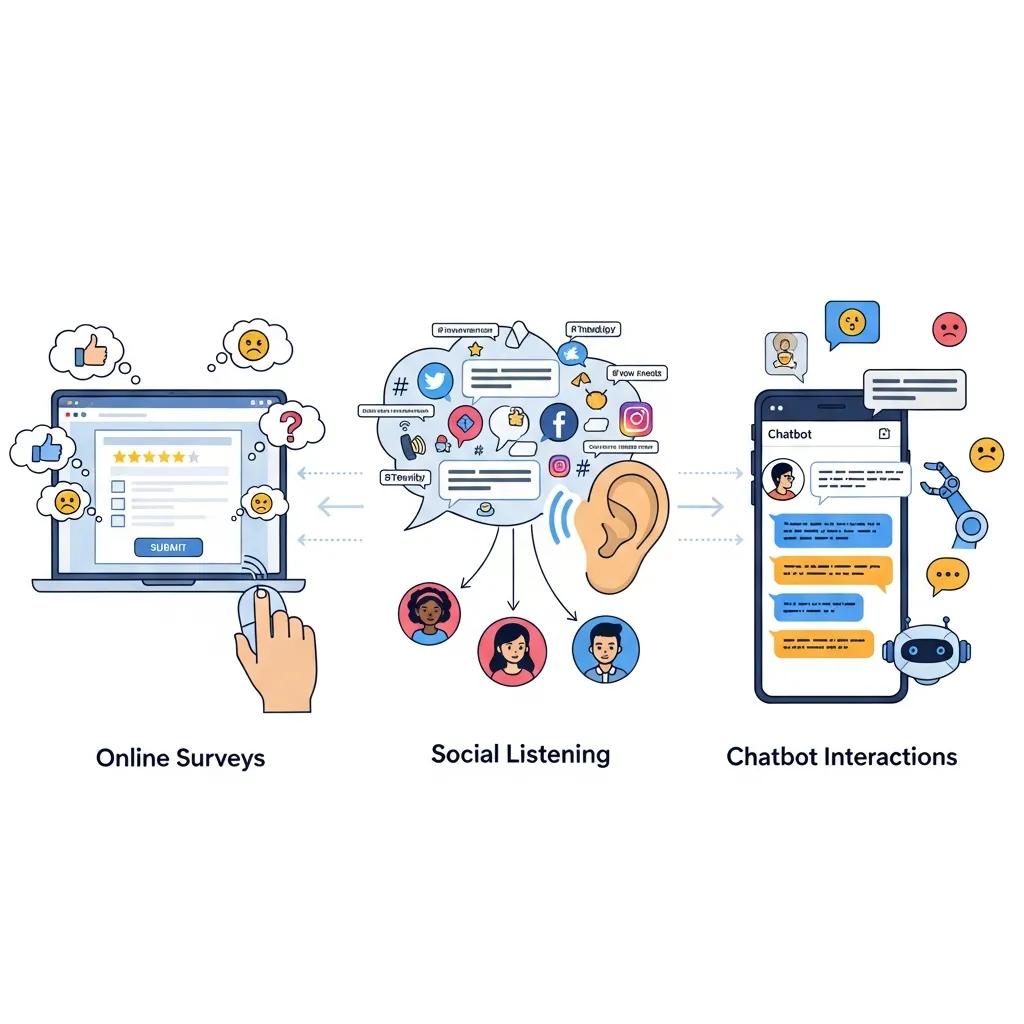
Customer feedback collection works best when each channel has a clear purpose. Surveys can gather structured ratings, while interviews reveal why someone gave a score. Reviews show public experiences; support chats may reveal recurring problems. First, choose the decision you need to make. Then select the channel and question that can answer it. Finally, explain how responses will be reviewed and used.
Key methods at a glance:
- Online surveys: Great for repeatable satisfaction tracking and NPS across your user base.
- Online reviews: Ideal for building social proof and improving local or category discovery.
- Social listening and review monitoring: Useful for real-time sentiment and spotting sudden issues.
To help you pick the right mix, the table below summarizes pros, cons, and recommended tools for various **survey methods** and **online reviews** strategies.
Surveys and feedback approaches compared for easy selection:
| Method | Best For | Pros | Cons | Recommended Tools |
|---|---|---|---|---|
| Online surveys | Scalable satisfaction & NPS | Provide structured metrics and easy segmentation | Response rates may be low without incentives | SurveyMonkey, Typeform, Qualtrics |
| Reviews & testimonials | Social proof & local search | Build credibility and influence discovery | Negative reviews require active management | Google Business Profile, industry directories |
| Chatbots & in-app surveys | Contextual, high-response capture | Real-time prompts that integrate with CRMs | Needs careful flow and UX design | Chatbot platforms, in-app SDKs |
This comparison helps teams choose the right mix based on scale, context, and resources. A multi-channel program usually gives the most complete picture—numbers for trend spotting and comments for prioritization.
Customer Feedback Collection with Online Surveys
Choose the Right Channel for Your Survey
Online surveys work via email, website intercepts, in-app prompts, and SMS—each channel tuned for context and response rate. Email fits post-purchase or scheduled NPS panels where you can ask more questions. Website intercepts capture intent during critical flows like checkout. In-app surveys are best right after a key feature is used. SMS drives high open rates for very short CSAT queries.
Design Concise and Focused Surveys
Keep surveys to 3–6 questions, focus on one main metric per send, and include a single open-ended question for actionable verbatim. Good timing, a clear note about how feedback will be used, and modest incentives improve completion and response quality.
Utilize Sample Survey Question Templates
Sample survey question templates:
- Transactional CSAT: “How satisfied were you with your recent purchase?” (1–5 scale)
- NPS: “How likely are you to recommend us to a colleague?” (0–10 scale)
- Open follow-up: “What one change would most improve your experience?”
Downloadable Resource: Essential Survey Templates
Get started quickly with our ready-to-use survey templates for NPS, CSAT, and CES. Customize them for your specific needs and start gathering valuable customer insights today!
How can businesses collect and manage online customer reviews and testimonials?
To effectively manage your **reputation management** strategy, ask for reviews at the right moment, make it easy for customers, and respond professionally to every review. Request feedback soon after a positive interaction, provide direct links to review pages, and give optional prompts for testimonial quotes—without pressure. Respond quickly to negative reviews: acknowledge the issue, offer to resolve it, and take sensitive conversations offline when appropriate. Proactive **reputation management** through consistent engagement with **online reviews** can significantly impact customer trust and conversion rates.
If you want to use a quote in marketing, ask permission and use short, attributed excerpts. Adding Review or AggregateRating schema to product pages can improve discoverability. Treat review management as an operational function so reputation signals become conversion assets.
How do key metrics like NPS, CSAT, and CES measure customer satisfaction?
NPS, CSAT and CES answer different questions. NPS asks about willingness to recommend, while CSAT checks satisfaction with a specific experience. CES measures how easy a task felt. Therefore, choose the measure that fits the decision. For example, use CSAT after a support interaction and CES after a difficult form flow. Then read open comments alongside the scores. The table below explains how to calculate and use each measure.
Research supports the strategic value of these metrics for improving customer service and overall performance.
Measuring Customer Service: NPS, CSAT, CES & AI Tools
Customer Service Management (CSM) focuses on improving satisfaction, loyalty, and business outcomes by delivering consistent, effective service. This paper reviews how teams measure CSM—with scores like CSAT, NPS, CES, and FCR—and how they use balanced scorecards, AI sentiment analysis, omnichannel tools, and Voice of Customer programs to act on those measurements.
Measuring Customer Service Management Practices for Excellent Service Performance, AK Othman, 2025
| Metric | What It Measures | Calculation | When to Use | Benchmark Example |
|---|---|---|---|---|
| NPS | Loyalty and advocacy intent | % Promoters − % Detractors (0–10 scale) | Periodic panels or post-onboarding | 30+ is strong in many industries |
| CSAT | Satisfaction with a transaction | % Positive responses on a 1–5 scale | After service interactions or purchases | 80%+ for high-service operations |
| CES | Ease of completing a task | Average effort rating on a 1–7 scale | When diagnosing friction in processes | Lower scores indicate less effort |
Resource: Customer Feedback Assessment Tool
Unsure which metrics to prioritize? Our interactive assessment tool helps you evaluate your current feedback strategy and recommends the best metrics (NPS, CSAT, CES) and **survey methods** for your business goals.
What is Net Promoter Score and how is it calculated?
Net Promoter Score (NPS) asks one question about how likely a customer is to recommend you on a 0–10 scale. Scores of 9–10 are promoters, 7–8 are passives, and 0–6 are detractors. Calculate NPS by subtracting the percent of detractors from the percent of promoters; results range from −100 to +100. NPS is most useful at lifecycle milestones—post-onboarding, 30–90 days of use, or after major launches—because it signals referral and retention potential. Follow-up questions for detractors uncover root causes; promoter feedback highlights advocacy opportunities.
How to use Customer Satisfaction Score and Customer Effort Score effectively?
CSAT captures short-term reactions with a 1–5 scale question; CES asks how much effort a customer expended to complete a task. Use CSAT after support calls, deliveries, or appointments to monitor quality and coach teams. Use CES when redesigning processes—returns, onboarding, or checkout—to reduce friction. Operational steps include setting short-term targets, routing low scores into follow-up workflows, and aggregating CSAT/CES by touchpoint so you address the highest-impact problems first.
How can digital marketing services integrate customer feedback for growth?
Customer feedback collection can inform SEO and website changes. First, look for repeated customer questions and words that appear in service requests. Then use them to clarify page copy and FAQs. Also note usability problems, such as a confusing form or unclear next step. Test a focused change and compare inquiries with the earlier baseline. A custom marketing plan can help assign owners and measures to these improvements.
Practical integration paths include:
- Mining feedback for long-tail keywords and FAQ topics to feed SEO and content calendars.
- Using testimonials and review snippets as trust signals on landing pages to increase conversions.
- Deploying chatbots to qualify leads and capture post-interaction CSAT for campaign optimization.
MarketMagnetix Media Group applies these patterns across services—AI optimization, SEO, web design, chatbot development, and social ads—so feedback directly informs site improvements, messaging experiments, and automated capture. That creates a feedback-to-growth loop where customer voice guides content, ads, and UX tests.
How Customer Feedback Collection Informs SEO and Content Strategy
Feedback reveals the words customers use to describe problems and desired outcomes. Those verbatim phrases map to long-tail keywords and FAQ topics your content should answer. Turn real customer comments into blog posts, FAQs, and how-to guides to match search intent and improve visibility for People Also Ask and niche queries. Adding FAQPage schema helps search engines and AI assistants surface answers directly. Basing your editorial calendar on customer questions also strengthens internal linking and topical authority.
How to use feedback to improve web design and user experience?
Use feedback to identify usability issues, prioritize fixes by frequency and business impact, and validate changes with A/B tests. Qualitative comments often explain layout confusion; quantitative metrics show conversion impact. Common fixes include simplifying navigation where users get stuck, clarifying CTAs when people hesitate, and reducing form fields when CES signals too much effort. Combine heatmaps, session recordings, and targeted surveys to form hypotheses designers can test quickly for measurable uplift. Feeding feedback into the UX backlog keeps design aligned with real user needs and business goals.
What are the benefits of AI-powered feedback analysis and chatbot collection?

AI can sort large sets of customer comments into themes. However, automated labels can miss context or misread tone. First, define the questions you want the analysis to answer. Then check a sample of tagged comments against the originals. Chatbots may collect short ratings after a service interaction if customers can opt out. Finally, review patterns with a person before changing policy or making public claims.
Integrating AI chatbots with CRM systems demonstrates how technology can transform feedback collection and customer service.
AI chatbots in CRM for customer service & feedback
As inquiry volumes grow, teams need ways to maintain service quality and agent efficiency. CRM systems centralize customer data, and AI—especially chatbots—has become a key tool to automate routine queries, collect feedback, and speed response times. Well-implemented chatbots free agents for higher-value work while keeping customers satisfied.
…customer service automation and user satisfaction: An exploration of AI-powered chatbot implementation within customer relationship management systems, AKR Sadhu, 2024
| AI Feature | What It Does | Business Benefit | Example Use Case |
|---|---|---|---|
| Sentiment analysis | Labels comments as positive, negative, or neutral | Helps prioritize urgent negative trends | Detects a spike in complaints after a release |
| Topic clustering | Groups similar comments into themes | Focuses teams on high-frequency issues | Uncovers recurring checkout errors |
| Automated tagging | Adds structured metadata to responses | Speeds routing to owners and dashboards | Automatically routes product bugs to engineering |
How do AI tools analyze customer sentiment and trends?
AI scores text for polarity and intensity, then groups comments with clustering algorithms to reveal topic trends over time. Outputs include sentiment scores, topic tags, and priority flags. Dashboards visualize trends and alert on anomalies—like a sudden rise in negative sentiment after a release—so teams can investigate quickly. Prioritization typically blends frequency and sentiment severity to surface the highest-impact issues. When integrated with product backlogs and customer success workflows, AI output leads to measurable improvements.
AI-powered sentiment analysis also produces useful signals for digital marketing from otherwise unstructured feedback.
AI sentiment analysis for digital marketing & feedback
This review examines how AI-driven sentiment analysis supports digital marketing, especially inside customer feedback loops for IT services. In a data-driven marketing world, extracting customer emotion from social posts, reviews, transcripts, and chat logs helps teams personalize messaging, increase engagement, and improve responsiveness.
AI-Powered Sentiment Analysis In Digital Marketing: A Review Of Customer Feedback Loops In It Services, R Paul, 2023
How can chatbots automate instant customer feedback collection?
Chatbots collect feedback by triggering short, contextual surveys after key events—support chats, checkout, or feature use—and by asking for quick ratings when signals indicate a strong experience. Well-designed flows use conditional logic to keep surveys brief, ask one primary metric question, and include an optional open response for context. They also handle consent and privacy inline. Responses feed into CRM and analytics systems to enable segmentation, low-score follow-ups, and real-time dashboards for product and marketing teams. This embeds feedback into operations without heavy manual effort and improves response rates.
Build a Customer Feedback Collection Loop
Step 1: Collect Feedback Across Channels
Closing the loop follows a repeatable four-step process—Collect → Analyze → Act → Follow up—that turns insights into measurable change and shows customers their input matters. Collect across channels (surveys, reviews, chatbots) with clear objectives for each metric.
Step 2: Analyze and Tag Responses
Analyze with metrics and AI to triage issues. Tag responses weekly, using AI to surface high-frequency issues and identify trends in **customer feedback**.
Step 3: Act on Prioritized Fixes
Act by converting prioritized items into experiments or fixes. Implement prioritized fixes in short sprints and validate impact with A/B tests.
Step 4: Follow Up and Communicate Results
Follow up to communicate results to customers and stakeholders. Notify respondents and publish change logs to show responsiveness. Successful loops assign owners, set timelines, and track KPI improvements like lower CES, higher CSAT, and improved NPS.
These steps create a cadence that converts customer voice into continuous improvement and measurable gains in retention and conversion. Use the operational checklist below to embed the loop into your team’s workflow.
Operational checklist for a closed-loop program:
- Define metrics and sampling cadence for NPS, CSAT, and CES.
- Assign owners for triage, prioritization, and implementation.
- Schedule weekly digests and monthly strategy reviews to turn themes into backlog items.
- Set follow-up templates and timelines to notify customers when changes are made.
Downloadable Resource: Closed-Loop Feedback Checklist
Ensure every piece of **customer feedback** leads to action with our comprehensive checklist for building and maintaining an effective closed-loop feedback program. Perfect for optimizing your **reputation management** efforts.
If you need help executing, MarketMagnetix Media Group offers services to align strategy and delivery—turning feedback into prioritized roadmaps, integrated dashboards, and campaign optimizations. To link feedback to measurable product and marketing KPIs, schedule a consultation with MarketMagnetix to identify the highest-impact opportunities.
What are the steps to collect, analyze, act, and follow up on feedback?
A customer feedback collection loop needs a goal, an owner and a response plan. First, choose the channels and keep the questions short. Next, bring answers into one place and tag recurring issues. Then prioritize a change that the team can test. Afterward, tell customers what changed when it is appropriate. Review the process regularly so unresolved issues do not disappear in a dashboard.
How does closing the feedback loop improve loyalty and business performance?
Closing the loop means acknowledging an issue and explaining the next step. For example, a team can tell a customer when a form has been fixed. Then it can check whether the new version solved the problem. Track repeat contacts and satisfaction over time to see whether the change helped. Finally, share verified findings with the staff who own the process. Avoid promising a retention gain before the results are measured.
Frequently asked questions
What are the best practices for designing effective customer feedback surveys?
Keep surveys short—3 to 6 questions—to boost completion. Combine a quantitative metric (NPS, CSAT, or CES) with one open-ended question for context. Write clear, neutral questions and send surveys soon after the interaction you’re measuring. Test timing, consider modest incentives to increase response rates, and tell respondents how you’ll use their feedback to encourage honest, useful answers. These **survey methods** are crucial for gathering actionable **customer feedback**.
How can businesses make sure they act on customer feedback?
Create a structured feedback loop: collect consistently, analyze to surface trends, prioritize actions by impact, and assign owners with deadlines. Share regular updates with customers about changes and track KPIs to measure effectiveness. Embedding feedback tasks in sprint backlogs and dashboards ensures the work doesn’t get dropped and creates accountability. This is key for effective **reputation management**.
What tools can help automate customer feedback collection?
Several platforms make feedback collection easier. Chatbot tools like Intercom or Drift capture contextual responses and prompt surveys. Survey tools such as SurveyMonkey, Typeform, or Qualtrics handle distribution and analysis. CRM systems like HubSpot centralize responses, and AI sentiment tools help categorize and prioritize feedback so teams can act faster. These tools support various **survey methods** and help manage **online reviews**.
How can businesses measure the impact of changes made from customer feedback?
Track KPIs before and after changes: CSAT, NPS, retention rate, conversion, and support ticket volume. Use A/B testing when possible to isolate effects. Collect follow-up feedback from impacted users to confirm improvements. Regularly review results in team meetings to refine your approach.
What role does customer feedback play in product development?
Feedback guides product decisions by revealing real user needs and pain points. It helps prioritize features based on demand instead of assumptions, reduces development risk, and accelerates product-market fit. Involving customers in ongoing feedback cycles builds loyalty and creates advocates who support product growth.
How can businesses effectively close the feedback loop with customers?
Close the loop by collecting feedback, analyzing and prioritizing insights, implementing changes, and then telling customers what you changed. Use email updates, release notes, or social posts to share fixes. Follow up directly with users who reported problems to confirm resolution. This transparency builds trust and encourages ongoing engagement, which is vital for **reputation management**.
For further guidance, see the Google Analytics guide to key events. Also explore our guide on Enhance User Experience with Effective Customer Journey Maps.


