
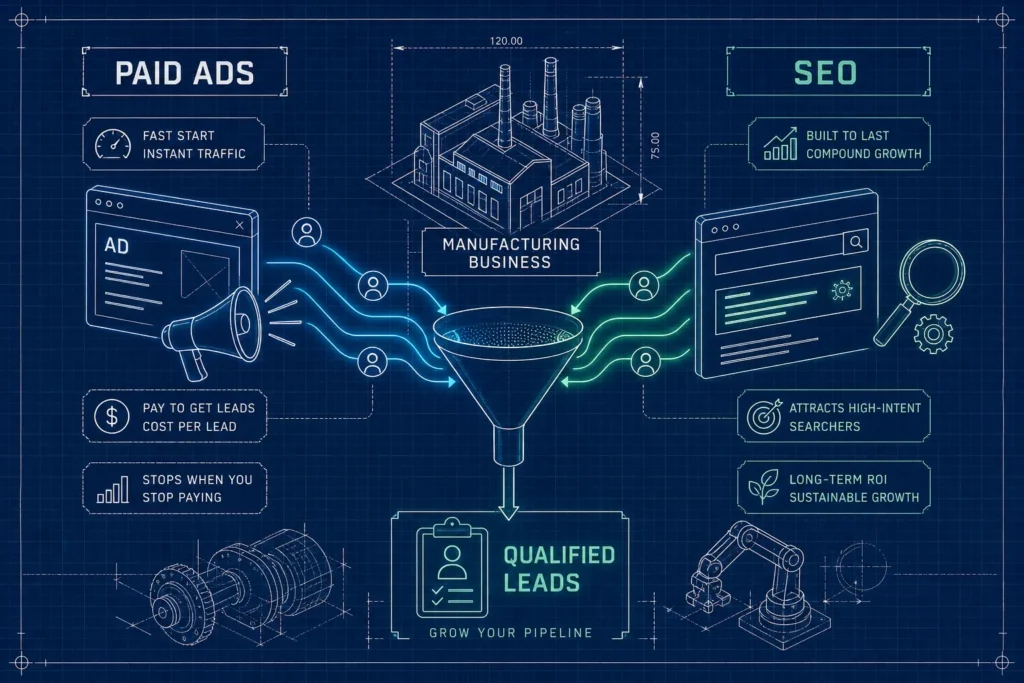
Paid ads vs SEO is a planning question for manufacturers seeking qualified leads. Each channel serves different needs and timelines. Compare them using your capabilities, current visibility, budget, and sales data, then decide how they should work together.
Agencies that build integrated client-acquisition systems exclusively for manufacturers approach this differently from generalists. They measure success in RFQs and qualified sales opportunities, not clicks or session counts. From that vantage point, the question shifts from “which channel wins” to “what is each channel actually built to do, and are we using it that way.” The answer determines everything: budget split, timeline expectations, keyword strategy, and how you measure whether any of it is working.
What follows is a practical breakdown of both channels, real cost-per-lead benchmarks, timeline data, how capability type should drive channel selection, budget split guidance across growth stages, and the attribution piece most manufacturers skip entirely. Whether you’re mapping out B2B lead gen strategies for a niche specialty shop or a broad-market contract manufacturer, the framework is the same.
What Paid Search Actually Delivers for Manufacturers
The headline CPL benchmark for manufacturing Google Ads campaigns sits around $75 to $86 per raw lead, based on 2026 industrial search data. That number looks manageable until you factor in qualification rates. A form submission from someone pricing out a hobbyist project and a form submission from a purchasing manager sourcing a 5,000-unit contract both count as “leads” at the campaign level. Your cost per qualified lead depends on which inquiries meet your sales criteria. Calculate it from your own campaign spend and qualified RFQs.
Conversion rates for industrial PPC fall in the 3% to 8% range, and that spread matters. A broad capability keyword like “metal fabrication” converts differently than “AS9100 contract manufacturer Ohio.” The keywords that produce the highest-value leads are always transactional intent combinations: capability plus buying signal plus qualifier. “CNC machining supplier,” “injection molding quote,” “ITAR precision components”, these terms signal a sourcing decision in progress, not a research question. Negative keyword hygiene is what separates a quality campaign from a traffic campaign. Filtering out “how to,” “jobs,” “school,” and “definition” terms is not optional; it’s what keeps your spend pointed at buyers instead of researchers.
Paid search does deliver traffic from day one. What it does not do is guarantee RFQs from day one. Campaigns typically need two to four weeks of optimization before they reach efficient CPL. More importantly, the cost structure never changes: every lead requires ongoing spend. The moment budget stops, traffic stops. Paid search scales with budget, not time, a fundamental constraint that becomes significant when you compare it to SEO’s cost trajectory over 18 to 24 months. When evaluating manufacturing paid ads vs. SEO for lead generation, this distinction in cost behavior is where most manufacturers underestimate the long game.
What SEO Builds That Paid Search Cannot Replicate
Organic results depend on your starting point, competition, and pace of work. Set review milestones, then compare progress with qualified inquiries and sales outcomes. The starting point matters significantly. A site with solid technical health and existing content authority moves faster than one being rebuilt from scratch. That timeline is not a weakness in the channel; it’s the mechanism of the compounding asset.
The lead quality difference between organic and paid search is structural, not incidental. SEO-sourced leads convert from MQL to SQL at 51%, versus 26% for paid search leads. The lead-to-customer close rate benchmark for organic search sits at roughly 14.6%. A useful capability page can help an engineer assess fit before making contact. Compare lead quality by channel using your own qualification data. They sought you out. That behavioral difference shows up in close rates.
The cost structure is what makes SEO a compounding asset. A well-built capability page or application-specific content piece continues to attract qualified searches eighteen months after publication with no ongoing per-click cost. Over a twenty-four month horizon, the effective CPL from organic search typically drops well below the equivalent paid search CPL as content authority matures. As content coverage grows, review the return from organic search. Reallocate budget when the evidence supports the change.
Manufacturing Paid Ads vs. SEO for Lead Generation: Matching Channel to Capability Type
For manufacturers competing on widely-searched capabilities, metal fabrication, injection molding, CNC machining, organic rankings on head terms take time and require substantial content authority to earn. For immediate lead flow on those competitive terms, paid search gives you placement on day one while SEO catches up. The tradeoff is cost. High-competition transactional keywords in manufacturing carry higher CPCs, and those CPCs reflect the commercial value buyers and competitors have already priced in.
Specialty and niche capabilities are a different story entirely, and SEO is often the stronger channel for them. Specialist manufacturers may target narrow searches tied to materials, processes, or requirements. Low search volume can still matter when the query matches valuable work. These specification-heavy, long-tail terms, material grade, tolerance class, certification, application, are typically low-competition in paid search and highly rankable through SEO. For niche capabilities, organic search can outperform paid search on both lead volume and lead quality faster than broad-market manufacturers expect. The reason is simple: when a buyer searches “Swiss-turn medical device components AS9100 contract manufacturer,” they are already deep in a sourcing decision. That search is practically an RFQ prompt.
Budget Splits for Manufacturing Paid Ads vs. SEO for Lead Generation
For manufacturers with limited organic presence, a 70/30 split favoring PPC over SEO in the first three to six months prevents a lead gap while content builds authority. PPC captures immediate demand; the SEO investment running in parallel means compounding returns start accumulating without a waiting period before you launch campaigns. At a $5,000 monthly budget, that means roughly $3,500 toward paid search campaigns and $1,500 toward content and technical SEO. With a $10,000 monthly budget, that example assigns $7,000 to paid search and $3,000 to SEO.
Once organic leads become consistent, review whether a more balanced allocation makes sense. Use qualified lead costs and pipeline contribution to guide the decision. Paid search stays active on the highest-value transactional terms and any new capability launches. SEO absorbs a larger share because its CPL is dropping as rankings mature. This is where the integrated model starts outperforming either single-channel approach on a blended cost-per-qualified-lead basis. Track blended cost per lead as the mix changes. Compare it with lead quality and sales outcomes before deciding whether the allocation works.
Established manufacturers with strong content coverage and page-one rankings often reach a 30/70 PPC-to-SEO split. At this stage, paid search functions as a precision tool: defending branded terms, targeting competitor queries, and supporting high-urgency campaigns like capacity announcements or short-run programs. Organic search carries the primary pipeline load.
Attribution Tracking: The Missing Piece That Makes Both Channels Accountable
A manufacturer running both paid and organic efforts without proper attribution is making budget decisions based on incomplete information. Clicks do not distinguish between someone doing background research with no sourcing intent and a purchasing manager sourcing a contract. Form submissions without source tagging cannot tell you whether the RFQ came from a Google Ad, a capability page, or a LinkedIn outreach campaign. The result is that budget allocation decisions get made on instinct instead of pipeline data.
Real attribution connects RFQ submissions, phone call events, scheduling activity, and contact form completions back to the specific page and campaign that generated them. Use consistent campaign parameters, suitable call tracking, and CRM source fields. Preserve the available source information as an inquiry moves through sales. A useful lead record connects the available source, landing page, and sales outcome. Some organic keyword details will remain unavailable.
The most practical tool stack for a mid-market manufacturer combines Google Analytics 4, Google Search Console, UTM discipline, a CRM with source field population (HubSpot and Salesforce are commonly used options), and call tracking if RFQs arrive by phone. This setup makes every paid and organic dollar defensible in a conversation with ownership or a private equity board. Without it, you’re reporting on traffic when the conversation that matters is about pipeline.
MarketMagnetix builds attribution into every engagement from the start, tying campaign spend and content assets back to RFQs and qualified leads rather than session counts. That’s what makes it possible to report cost-per-qualified-lead by channel rather than cost-per-click, and it’s what gives clients the data to make allocation decisions based on actual sales opportunities rather than marketing proxies.
Why an Integrated System Beats Either Channel Alone
Manufacturers who force a paid-versus-organic choice usually do so because they can’t see the contribution of both channels clearly. When attribution is built correctly, the question shifts from “which channel is better” to “which channel is producing the most qualified leads at what cost right now, and how does that change over the next twelve months.” That’s an optimization problem, and it has a data-driven answer. Long sales cycles make this context useful. It helps teams explain pipeline changes and choose the next action.
When paid search captures immediate RFQ demand on high-intent transactional keywords while SEO builds capability visibility and compounding organic authority in parallel, the total qualified lead flow exceeds what either channel produces alone. Paid search funds itself through near-term RFQs while SEO builds the long-term asset. The budget split shifts dynamically as SEO matures. The result is a lower blended CPL over twelve to twenty-four months than either single-channel approach can achieve.
Before allocating budget, review the site’s technical health, capability coverage, content, and lead attribution. Identify the gaps that affect qualified inquiries. MarketMagnetix’s Manufacturing Growth Diagnostic identifies where the pipeline is leaking before recommending a channel mix or budget allocation. It’s a data-first starting point that makes every subsequent investment more precise, because it grounds channel selection in your specific commercial situation rather than a generic playbook.
The Decision Framework, in Plain Terms
Paid search and SEO for manufacturing lead generation are not competitors. They serve different functions in the same pipeline. Paid search generates immediate RFQs on high-intent transactional searches. SEO builds capability visibility and compounding lead flow that reduces cost-per-lead over time. The right budget split depends on your growth stage, competition, and current organic visibility. Review those factors together.
The manufacturers who end up with a patchwork approach, some ads here, a few blog posts there, no clear attribution, typically generate leads without any insight into what’s working. They can’t rebalance budget intelligently because they don’t have the data. They can’t make the case for additional marketing investment because they can’t connect spend to pipeline. Attribution is what closes that gap. The advanced manufacturing case study shows dated visibility metrics and the first recorded RFQ, with measurement limits stated separately.
If you’re evaluating manufacturing paid ads vs. SEO for lead generation and aren’t sure which channel mix fits your commercial situation right now, reach out to the team at MarketMagnetix for a Manufacturing Growth Diagnostic. It identifies the specific gaps in your current pipeline system and gives you a concrete starting point for channel selection, budget allocation, and attribution setup built around how your buyers actually find and shortlist suppliers.


