

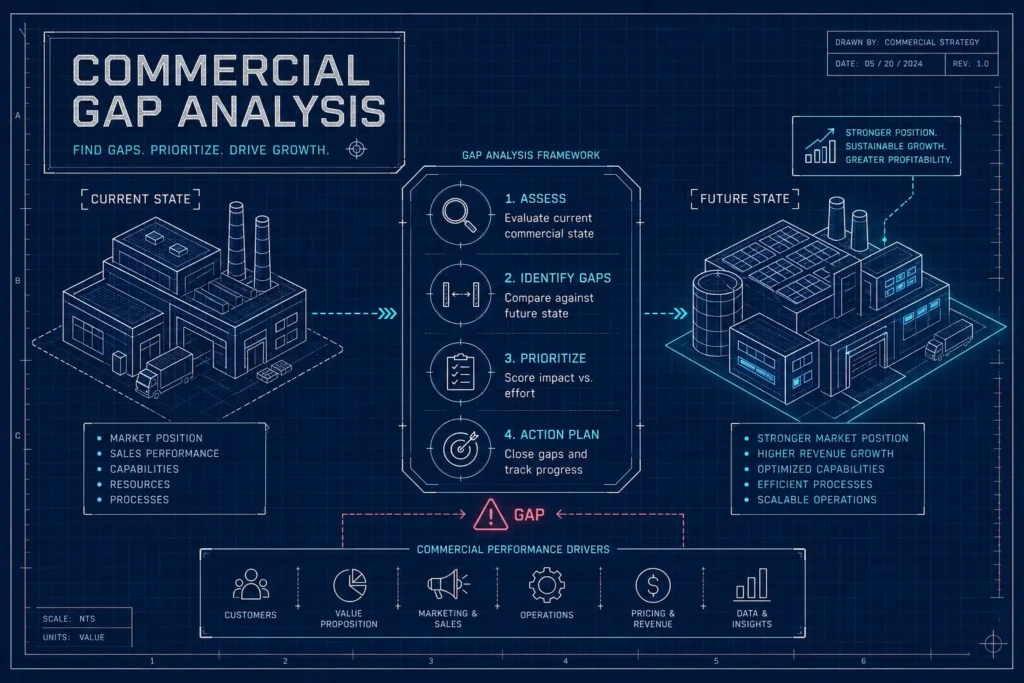
A commercial gap analysis examines how buyers find, assess, and contact your manufacturing business. It connects website performance, search visibility, lead attribution, and sales follow-up. Use the findings to identify where qualified interest stalls and what to improve first.
The real issue is almost always structural. It lives inside the commercial system itself: the path a potential buyer takes from “we need a new supplier” to “let’s contact this company.” When that path has breaks in it, qualified demand simply doesn’t convert, and you’d never know which break is responsible without a systematic look. A manufacturer commercial gap analysis is designed to find exactly that. The process examines how buyers find you, what they see, and whether they can take the next step. It reveals where qualified interest stalls. This article explains each layer of the assessment and the gaps to look for. Use it to organize findings into clear priorities.
What a manufacturer commercial gap analysis actually means
Before running any analysis, you need to be clear about what you’re analyzing. A commercial gap assessment is not an operational audit. It has nothing to do with OEE, fill rate, cycle time, or production throughput. Those are the right metrics for running your plant efficiently. The analysis follows the buyer’s experience from initial research to a quote request. Review each step in that journey. A plant can run at 95% OEE and still generate zero qualified leads if the commercial side isn’t working. These are two entirely different performance systems.
The commercial system has four distinct layers, and each one can independently suppress RFQ volume: pipeline visibility, website conversion, search presence, and lead attribution. Think of them as connected segments of a pipeline. Qualified buyer interest enters at the top, and it either makes it through to an RFQ or it drops out somewhere along the way. A gap in any single layer can create a suppression effect that looks, from the outside, like a market problem when it’s actually a structural one.
RFQ volume tied to specific capabilities is a key metric for diagnosing whether your commercial system is working. Traffic, impressions, and click-through rates don’t close that loop. They tell you about activity. The question is whether that activity produces sales opportunities. Trace inquiries back to their sources to investigate the connection.
Commercial Gap Analysis for Pipeline Visibility
Pipeline visibility isn’t a CRM report showing open deals. It’s the ability to trace buyer interest from the first touch, a Google search, a trade publication mention, a LinkedIn post, all the way through to a submitted RFQ or a scheduled call. Most manufacturers have a serious gap here, not because they lack data but because they rely on anecdotal signals. “We got a call from a plant manager in Ohio” is information. It’s not a pipeline.
Without defined funnel stages and tracking at each one, you can’t tell whether low RFQ volume is a top-of-funnel problem or a bottom-of-funnel problem. Those two diagnoses have completely different fixes. If buyers can’t find you, you need to address search presence. If buyers are finding you but leaving without making contact, you have a conversion problem on the site. These are not interchangeable solutions.
Mapping your current data coverage
The first step in any commercial capability assessment is to map out what data you currently have at each funnel stage and identify where the data stops, because that’s usually where the gap lives. A simple spreadsheet with five columns (stage, data source, current metric, owner, and gap notes) takes less than an afternoon to build and immediately shows you where the manufacturing gap assessment needs to focus first.
Commercial Gap Analysis for Website Conversion
Manufacturing websites often fail to generate RFQ form submissions even when they have adequate traffic. In most cases, the site doesn’t answer the buyer’s qualification questions fast enough, and the friction lives in the content, not the form. A procurement engineer or engineering buyer lands on the page looking for specific process details, material and tolerance ranges, certifications, and application context. When those aren’t visible quickly, they leave. The gap isn’t traffic. It’s what the site does with the traffic it already gets.
What a high-converting capability page does differently
A high-converting capability page does specific things. It uses process-specific language that matches what the buyer searched for. Material and tolerance ranges appear clearly on the page, with supporting detail available in a PDF. It connects capabilities to industries and applications the buyer recognizes, and it shows certifications prominently. The next step, requesting a quote or scheduling a call, is obvious and easy to find. Many manufacturers have a small number of existing pages that could become RFQ-generating assets with targeted structural changes. The content is often already there. It’s just not organized around how buyers actually make sourcing decisions.
Capability page checklist
A practical self-audit: pull your top 10 capability or service pages and review each one against the questions a sourcing engineer asks before submitting a quote request. Does the page confirm you work in their industry? Can they verify your processes and tolerance ranges? Does it show certifications? Is the next step clear? Score each page honestly. This process gap assessment will show you exactly where the conversion gap sits and which pages to prioritize first. A gap analysis template for manufacturers can make this step faster, if your team wants a structured scoring format, MarketMagnetix can provide one as part of the initial diagnostic.
Search presence gaps that hide you from qualified buyers
Many manufacturers have some Google presence, but for the wrong queries. Ranking for a company name or a city name doesn’t generate RFQs. Ranking for “precision CNC machining aerospace titanium” or “custom HDPE injection molding medical components” does. A performance gap analysis for your search channel starts with an honest audit of which queries are actually driving traffic and whether those queries match the capabilities and contract types you want to win.
Procurement engineers search in predictable patterns: process or part type, combined with material or specification, certification, and sometimes location or production volume. Queries like “ISO 9001 certified sheet metal fabrication supplier” or “high-volume injection molding short lead time” are how real buyers find real suppliers. If your site isn’t built around that language, you’re not in consideration for those searches, regardless of how strong your actual capabilities are.
Reviewing AI Search Visibility
There’s a second dimension to search presence that most manufacturers haven’t addressed yet. AI tools like ChatGPT, Perplexity, and Gemini are increasingly part of how B2B industrial buyers research and shortlist suppliers. When a procurement manager asks an AI assistant which manufacturers specialize in tight-tolerance turned parts for defense applications, the companies that appear are the ones with structured, authoritative, clearly written content about those capabilities on their websites. Manufacturers without that content are invisible in this research channel, and most of them don’t realize it’s happening. AI search visibility is no longer a future consideration for manufacturers, it’s already part of the current B2B buying journey.
A quick search diagnostic is a practical starting point. Identify the five capability-specific queries a new buyer would use to find your company. Search for each one, record whether you appear and where, then look at the content that outranks you and note what it includes that yours doesn’t. This isn’t a full SEO analysis. It’s a commercial diagnostic that shows you where your search presence is strong, thin, or completely absent.
Lead Attribution in a Commercial Gap Analysis
When a manufacturer receives an RFQ but can’t trace it back to a source, a specific page, a campaign, or a search query, there’s no way to know what’s working. Without that information, marketing spend becomes guesswork, and high-performing channels get defunded alongside low-performing ones simply because there’s no data to distinguish them. Attribution isn’t an analytics project. It’s a commercial accountability system.
The most common attribution blind spots in manufacturing companies follow a familiar pattern:
- Form submissions with no source tracking captured at the point of submission
- Phone calls that aren’t connected to the pages or campaigns that generated them
- Google Analytics data that stops at the session level without linking to actual inquiries
- CRM records with no channel information, so the sales team has no context on where a lead came from
These gaps are fixable. A minimal viable attribution setup includes UTM tracking on campaign links, source capture built into your forms, call tracking tied to specific pages, and a simple intake field asking how the buyer found you. These are low-cost to implement and fast to deploy. Once in place, they clarify which parts of your commercial system are generating real buyer activity versus just generating noise.
Running the manufacturer commercial gap analysis: how to structure your starting point
Rather than trying to run a full commercial capability assessment across all four layers at once, start where the symptoms are most visible. Low website traffic points to a search presence gap. High traffic with no inquiries points to a conversion gap. Inquiries that don’t turn into qualified quotes suggest a pipeline visibility or attribution problem. Starting with the highest-pain layer creates faster momentum and a clearer connection between the work and the result.
For manufacturers who want a structured framework without building it from scratch, MarketMagnetix offers a Manufacturing Growth Diagnostic that maps your current commercial system against each of these four layers, surfaces where the gaps are, and shows what order of operations makes sense for addressing them. The output is a prioritized action list, not a sprawling audit document with no clear entry point.
Once you’ve identified the gaps, the prioritization logic is straightforward. Rank each gap by three factors: its impact on total RFQ volume, how quickly it can be addressed, and what resources it requires. A search presence gap that affects all inbound discovery typically outranks a single page’s conversion weakness, because fixing it lifts the whole top of the funnel. The goal isn’t to fix everything at once. It’s to fix the right thing first, measure the result, and then move to the next layer. Assign a specific owner to the highest-priority gap, set a 30-day checkpoint, and re-run the relevant part of the audit against the baseline you documented at the start.
The core argument: this is a visibility problem, not a capabilities problem
Most manufacturers with thin RFQ pipelines don’t have a capabilities problem. They have a commercial visibility problem. The processes are strong, the quality systems are real, and the workforce can deliver, but none of that matters commercially if the buyers who need those capabilities can’t find the company, can’t confirm it’s a fit from the website, or can’t easily make contact when they’re ready to inquire.
A structured manufacturer commercial gap analysis gives you a systematic way to find exactly where the breakdown is: in how buyers find you, what they see when they arrive, whether they can take the next step, or whether you can trace that step back to a source. None of these gaps are permanent. But you can’t close what you can’t see, and you can’t prioritize what you haven’t measured. Start with one layer, run the audit honestly, and follow the data to the fix. See the advanced manufacturing case study for an example that separates search visibility indicators from a recorded RFQ milestone.


