

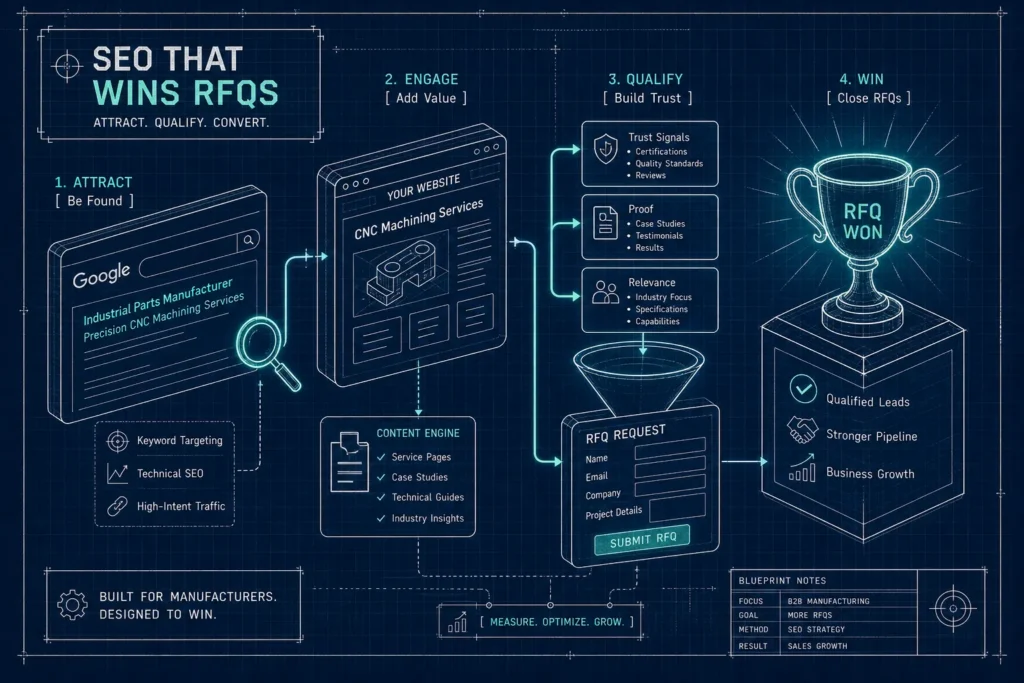
Most manufacturers investing in manufacturing SEO are borrowing strategies built for software companies and e-commerce brands. Those tactics may work for software and ecommerce brands. Yet procurement engineers research suppliers differently. They need evidence of capabilities before requesting a quote. The result is a steady accumulation of traffic from people who will never send an RFQ, and a qualified buyer pool the website never reaches.
B2B manufacturing SEO is a distinct discipline. The keyword logic is different, the buyer behavior is different, and the conversion objective has nothing to do with cart adds or trial signups. It’s about earning a spot on a procurement shortlist. MarketMagnetix documented exactly this outcome for an aerospace and defense manufacturer: 82 Page 1 keyword rankings built on a capability-first approach, alongside a separately documented first RFQ 34 days after full-package launch. The advanced manufacturing case study provides the dated keyword and RFQ evidence, with its measurement limits.
Why standard SEO playbooks fall short for industrial companies
Generalist agencies optimize for traffic volume. They target high-search-volume keywords, build backlinks, and report success in sessions and rankings. For a precision machining shop or a specialty casting manufacturer, that approach fills an analytics dashboard while doing nothing for the commercial pipeline. The buyer pool for these capabilities is small, technically sophisticated, and searches in ways that generic keyword tools systematically undervalue.
How procurement engineers actually search
Industrial buyers don’t search the way consumers do. They search by process, material, certification, and application. A buyer sourcing a titanium aerospace component might search “Ti-6Al-4V 5-axis machining AS9100” rather than anything resembling “machining company.” Standard SEO playbooks ignore these queries because their monthly search volume looks too low to prioritize. The commercial intent behind them is exceptionally high, and competition for those terms is often minimal.
What “ranking” actually means for a manufacturer
Ranking on page 1 for “manufacturing company” produces zero commercial value. Ranking for “ITAR registered precision machining Midwest” puts a manufacturer directly in front of a shortlist candidate with an active sourcing need. For industrial marketing, measure SEO through RFQ submissions and qualified leads. Then connect those outcomes to capability pages and attributed revenue, rather than relying on sessions alone.
Manufacturing SEO Strategies for Processes, Materials, and Certifications
Effective manufacturing SEO strategies build keyword strategy around four modifiers stacked onto a core capability: process, material, certification, and vertical. “CNC machining” becomes “5-axis CNC machining Inconel AS9100 aerospace.” Each layer narrows the audience and raises commercial intent. These combinations may have lower search volume than broad terms. Compare qualified RFQs from each group to see which queries bring relevant buyers.
Certifications as buyer intent signals
Certification terms like ITAR, AS9100, ISO 13485, and NADCAP function as intent multipliers in industrial search. A buyer who includes a certification in their search query is past the awareness stage, they know what they need and are actively building a shortlist. Targeting these terms ahead of generic capability phrases is one of the highest-ROI moves in a manufacturing SEO strategy, and most manufacturers leave this territory completely uncontested.
Finding keyword gaps for manufacturing SEO strategies
Before building any content, manufacturers need a competitive keyword gap analysis: which capability and application terms do competitors rank for that you don’t? These gaps represent uncontested territory where a well-structured page can reach page 1 faster because competitive pressure is lower. Tools like Semrush or Ahrefs surface these gaps in hours. The findings almost always reveal that the most commercially valuable terms are sitting unclaimed, invisible to buyers who are actively sourcing.
Manufacturing SEO Strategies for Capability Content
A generic “CNC machining services” page competes with thousands of near-identical pages and gives a procurement engineer nothing to confirm fit. A page titled “5-axis CNC machining for aerospace structural components” answers the buyer’s implicit question before they ask it. Specific pages give buyers a clearer way to judge fit. Track qualified RFQs to test whether that content reaches the right audience.
Translating technical depth into search-visible content
Manufacturers routinely bury their most valuable capabilities inside PDFs, brochures, and internal documents that search engines can’t index. A 2026 MarketMagnetix industrial site audit identified a common technical issue: valuable details buried in files that search engines cannot read. These can include tolerance specifications, material grades, and process documentation. Turn that technical depth into structured web pages, materials guides, and process breakdowns. This makes the content discoverable and helps buyers decide whether to request a quote.
What a buyer needs before sending an RFQ
Procurement engineers need evidence before shortlisting a supplier. Show a capability match and relevant certifications. Add similar work and enough process detail for buyers to evaluate fit. Manufacturing website SEO only works when the pages themselves contain all four, traffic without this foundation produces form abandons rather than pipeline activity. The content and the conversion structure have to do the same job simultaneously.
RFQ-driven conversion architecture: the structure beneath the content
A manufacturing capability page needs a clear hierarchy. The H1 should lead with a direct capability statement, followed by process details, materials handled, tolerances, certifications, and relevant industries. A low-friction RFQ entry point comes next, with the call to action appearing above the fold and repeating at the bottom of the page. Hiding the contact point below extensive specification tables is one of the most consistent reasons manufacturing pages generate traffic without producing inquiries.
Technical checks for manufacturing SEO strategies
Manufacturing sites carry a specific set of technical problems that suppress rankings regardless of content quality. A 2026 MarketMagnetix industrial audit found duplicate content without canonical tags on 52% of sites reviewed, broken internal links on over 25%, and no Schema.org markup whatsoever on 78%. Product variants and filtered catalog navigation create index bloat that wastes crawl budget. Heavy technical imagery and uncompressed PDFs slow load times significantly. Orphan pages from past website migrations sit unindexed while carrying valuable capability information. A technical crawl of a manufacturing website typically surfaces 15 to 20 of these issues in the first hour.
Schema markup for capability and product pages
Structured data helps search engines understand and represent manufacturing content accurately. Four schema types are worth prioritizing:
- Service schema for capability and process pages, where the manufacturer is selling expertise rather than a physical product
- Product schema with MPN, material, and certification fields (modeled through additionalProperty where no native field exists) for catalog and component pages
- Organization schema with precise contact and location data to support geography-based searches
- FAQPage schemaadded to capability pages, with five to ten real buyer questions, to increase click-through rates and AI search citation share within 30 to 60 days
Skipping these implementations means ceding ground to competitors who are already using structured data to capture industrial buyer attention in 2026.
What real manufacturing SEO results look like: a documented benchmark
The aerospace and defense sector is one of the most competitive manufacturing verticals for search visibility. Buyers are technically sophisticated, supply chain decisions carry high risk, and certifications like ITAR and AS9100 function as baseline entry requirements rather than differentiators. Getting a manufacturer into page 1 visibility for meaningful capability terms in this vertical requires precise keyword architecture, not volume content production.
From invisible to 82 Page 1 keywords
MarketMagnetix documented a result for an aerospace and defense manufacturer: 82 Page 1 keyword rankings built on capability-specific page architecture, certification-targeted content, and a conversion structure aligned with RFQ behavior. That outcome didn’t come from publishing more content or chasing backlinks. It came from building the right pages around the right queries, structured to answer the specific questions procurement engineers ask before shortlisting a supplier.
Connecting rankings to actual RFQs
Rankings mean nothing commercially unless the pages they drive traffic to produce qualified inquiries. The same approach that reached 82 Page 1 keywords incorporated lead attribution: connecting form submissions, phone clicks, and RFQ entries to specific capability pages and campaigns. Well-optimized manufacturing RFQ pages regularly achieve conversion rates in the 4 to 8% range when the page matches high-intent search and removes friction from the contact process. That attribution makes industrial SEO more useful. It shows which pages produce sales conversations, not just visits.
A 90-day roadmap for manufacturing SEO strategies
Start by pulling your current keyword rankings and identifying which capability terms are missing from page 1. Cross-reference those gaps against your most valuable service lines and target industries. Then run a technical crawl to surface duplicate content, crawl errors, and page speed issues. Use those findings to prioritize manufacturing SEO strategies by buyer impact, then measure qualified inquiries after each change.
Prioritizing manufacturing SEO strategies by commercial impact
Not all SEO improvements carry equal commercial weight. For manufacturers, the correct priority order is:
- Build capability and application pages aligned to specific buyer intent, certifications, and target verticals
- Fix technical issues blocking crawling, indexing, and page speed
- Add Service, FAQPage, Organization, and BreadcrumbList schema to relevant pages
- Align conversion architecture on existing high-traffic pages so RFQ entry points are visible and friction-free
Chasing backlinks or publishing blog content before these foundations are in place produces minimal RFQ impact. The pages have to earn the ranking and convert the visitor. Both objectives require the same structural work.
When to bring in a manufacturing SEO specialist
The signal that it’s time to hire a specialist is when the gap between your search visibility and your competitors’ is measurable in RFQ volume, not just rankings. A generalist agency optimizes traffic. A manufacturing SEO specialist optimizes your commercial pipeline. The difference shows up in what gets measured: sessions and rankings versus RFQ submissions, qualified leads, and revenue attributed to specific capabilities and campaigns. If your current agency can’t draw a direct line from a keyword ranking to an actual sales conversation, the measurement framework isn’t built for manufacturing.
Manufacturing SEO strategies should reflect how procurement engineers evaluate suppliers and compare capabilities. They should help buyers decide which firms belong on a shortlist. The keyword strategy, content architecture, technical structure, and attribution system share one goal. They should connect the right manufacturer with a buyer making a sourcing decision. If search visibility is not producing enough qualified RFQs, investigate the gap. The MarketMagnetix Manufacturing Growth Diagnostic can help identify where buyers leave the path to a quote. Request your diagnostic to start closing them.


One response to “Manufacturing SEO Strategies That Actually Win RFQs”
[…] For further guidance, see the Google SEO Starter Guide. Also explore our guide on Manufacturing SEO Strategies That Actually Win RFQs. […]