

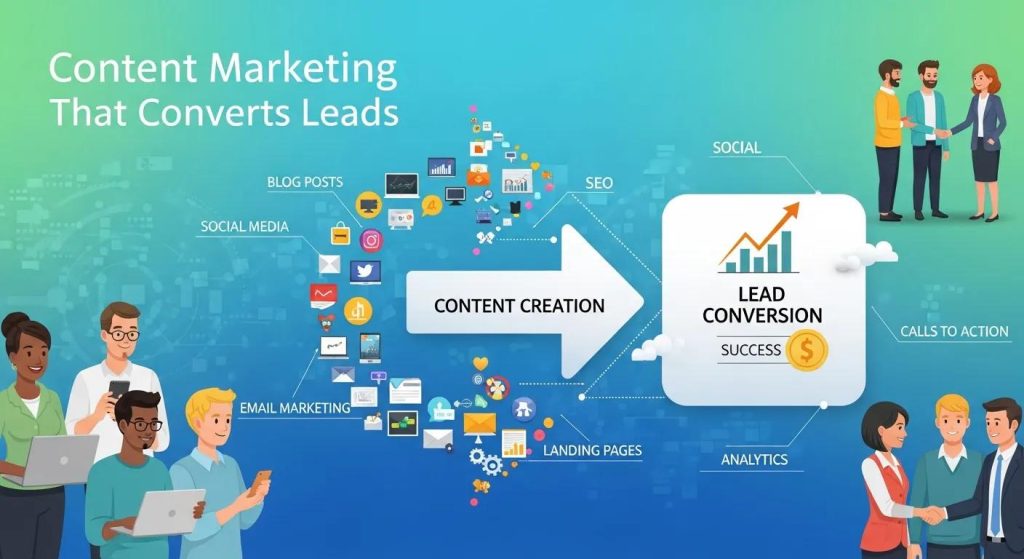
Content Marketing Strategies for Qualified Leads
Content marketing strategies connect useful information with the people you want to reach. Start with customer questions, relevant expertise, and a clear next step. Then choose formats and a publishing schedule your team can maintain.
What Are the Most Effective Content Marketing Strategies for Small Businesses?
High-impact content strategies for small businesses pair consistent, audience-centered content with distribution and conversion tactics that respect limited resources. They work by aligning content formats with buyer intent, leveraging local SEO to capture nearby demand, and creating repeatable lead magnets that convert casual visitors into contacts. Put simply: regular publishing plus tight conversion funnels produces predictable traffic and steady leads without big ad spends. Below is a prioritized list of tactics small teams should consider first, with a short reason for each.
The following list highlights proven priorities and why they matter:
- Blogging focused on local and long-tail topics to capture high-intent searchers and build topical authority.
- Local SEO and optimized service pages to turn geographically relevant searches into leads.
- Case studies that show measurable outcomes to reduce buyer friction and build trust.
- Short-form video and project galleries to provide visual proof and showcase your work.
- Email sequences and segmented nurturing to move prospects from interest to booking.
- FAQ and cornerstone pages to answer intent-driven queries and earn SERP features.
- Lead magnets (checklists, pricing guides) that trade clear value for contact information.
These priorities emphasize high-ROI activities small teams can start quickly. Consistently running one or two of these produces measurable results within months and creates a foundation for scaling content production and distribution. Once the basics are in place, layering in personalization and automation typically amplifies engagement and conversion.
How Can Personalized Content Drive Engagement and Growth?
Personalized content tailors messaging, offers, and user journeys for distinct audience segments, which makes your content more relevant and boosts conversions. The mechanism is simple: segmentation (by behavior, location, or intent) enables dynamic experiences—targeted email flows, regional landing pages, or CTAs tuned to referral source—that match expectations and reduce friction. The payoff is higher CTRs, better lead quality, and shorter sales cycles versus one-size-fits-all content. For small businesses, low-cost personalization tactics include basic email list segmentation, UTM-driven landing page variations, and dynamic CTAs tied to referral sources.
Start with obvious signals—referral URL, landing page visited, or recent email engagement—and map those to a relevant offer like a local pricing guide or appointment CTA. A simple micro-template: name the segment, state the specific problem, offer a clear next step, and add a short line of social proof. Small investments like this raise perceived value, encourage repeat visits, and generate engagement data you can use to refine personalization.
Which Content Formats Work Best for Small Business Audiences?
Different formats serve different moments in the buyer journey; matching format to intent improves efficiency and lead yield. Awareness content works well as short blog posts, local SEO pages, and social video that introduce problems and services. Consideration stage content benefits from long-form guides, comparison pages, and case studies that answer deeper questions. Conversion content is typically landing pages, quote calculators, and booking pages that remove friction. Small teams should prioritize formats they can produce reliably and repurpose across channels to multiply reach and impact.
Below is a practical comparison of formats for small businesses and expected outcomes:
| Content Format | Best Use Case / Audience | Expected Outcome / KPI |
|---|---|---|
| Blog posts (local long-tail) | Awareness for searchers researching problems | Organic traffic growth; SERP ranking for long-tail queries |
| Case studies | Prospects evaluating providers | Increase in qualified leads and close rate |
| Short-form video | Social engagement and visual proof | Higher social CTR and lift on service page conversions |
| Email sequences | Nurturing leads and re-engaging past customers | Improved lead-to-customer conversion rate |
| FAQ & cornerstone pages | Capture SERP features and answer intent | Featured snippets and reduced bounce rates |
This comparison clarifies which formats drive which KPIs and helps small teams prioritize. One long-form guide can be repurposed into short posts, email sequences, and video snippets to extend limited resources.
How Does AI Optimization Enhance Content Marketing Performance?
AI speeds idea generation, enables smarter personalization, and surfaces performance insights that improve outcomes. In practice, AI can analyze search intent and behavior to suggest topics, produce content drafts to shorten production time, and power recommendation engines that personalize site and email experiences. The tangible benefits are faster content production, greater relevance for users, and better conversion when the right offer appears for the right person. Human oversight and governance remain essential to protect quality and brand voice while using AI tools.
Three concrete ways AI raises content outcomes and what teams should expect:
- Personalization: AI uses behavior signals to serve dynamic content and recommendations, boosting engagement and average order value.
- Content ideation and clustering: Topic modeling surfaces gaps and clusters that build topical authority and reduce wasted effort.
- Performance optimization: AI quickly tests headlines, CTAs, and layouts to lift conversion metrics without exhaustive manual A/B testing.
These capabilities free content teams to focus creative work where it matters while AI handles repetitive analysis and personalization. For teams seeking outside help, MarketMagnetix Media Group offers an and strategic guidance to pilot these tools responsibly—keeping quality, compliance, and brand voice top of mind.
What AI Techniques Improve Content Personalization and Targeting?
AI techniques like natural language processing (NLP) for topic modeling, recommendation engines for behavioral personalization, and clustering algorithms for audience segmentation sharpen targeting and relevance. NLP uncovers user intent and semantic topics from queries and behavior, guiding better topic selection and on-page optimization. Recommendation systems surface individualized content and offers based on browsing patterns, lifting CTRs and conversions. Clustering combines multiple signals to reveal micro-segments you can target with tailored campaigns.
| AI Technique | Implementation / Tool | Benefit / Measurable Impact |
|---|---|---|
| NLP topic modeling | Topic-clustering tools and content briefs | Faster ideation; improved organic traffic for targeted clusters |
| Recommendation engines | Personalization platforms or CMS plugins | Higher onsite engagement and conversion lift |
| User-segmentation clustering | Analytics-driven segmentation workflows | More precise email targeting and better lead quality |
When paired with human editorial review, these techniques produce measurable gains—higher CTRs, longer time-on-page, and improved lead conversion. Start with the simplest technique (for example, basic segmentation), measure uplift, then expand to recommendation engines as confidence and resources grow.
How to Integrate AI-Driven Tools into Your Marketing Workflow?
Roll out AI with a pilot-and-scale approach: audit your current processes, run a focused pilot, measure results with clear KPIs, and scale while adding governance. Begin with an audit to spot production bottlenecks, data gaps, and analytics maturity. During the pilot, test a single use case—automated topic generation or subject-line optimization—over a set period and compare results to a control. If the pilot shows measurable improvement, expand the use case while adding review steps to protect brand voice and accuracy.
A practical pilot checklist: define the KPI, pick a representative content bucket, set a control group, document editorial workflows, and schedule regular quality reviews. This structure helps AI amplify human expertise—not replace it—and creates repeatable models for future adoption.
What Industry-Specific Content Marketing Tactics Work for Contractors, Law Firms, and HVAC Companies?
Industry-specific content succeeds when it matches buyer intent, respects regulatory limits, and captures local demand signals. Contractors and trades win with visual proof and clear project breakdowns; law firms and medical practices rely on long-form, authoritative content and comprehensive FAQ clusters to build credibility and capture intent-driven searches. Across industries, the rule is the same: align format with decision stage and localize messaging to convert nearby demand. The payoff is higher-quality leads and a shorter path to conversion while honoring industry constraints like privacy and compliance.
| Industry | Tactic | Why it works / Example KPI |
|---|---|---|
| Contractors & Trades | Project galleries and localized service pages | Visual proof increases lead inquiries; KPI: increase in contact form submissions |
| Law Firms | Long-form guides and FAQ clusters | Builds authority and captures high-intent searches; KPI: organic leads from topic clusters |
| HVAC Companies | Seasonal maintenance content and video demos | Timely content drives local search traffic; KPI: booked service calls during peak season |
These tactics demonstrate how different industries turn content into measurable business outcomes. Prioritizing local SEO and trust signals—case studies, verified reviews, and compliant client stories—increases lead quality and shortens sales cycles for service businesses.
How to Tailor Content Marketing for Contractors and Trades Businesses?
Contractors gain the most traction from content that highlights completed projects, explains the process clearly, and answers common pre-sale questions. Project galleries and before/after videos provide visual proof that lowers perceived risk and speeds decisions. Service-area pages optimized for local search capture nearby prospects, and short case studies with practical metrics (timeline, budget range) show reliability and capability. Structure content so visitors can quickly find the right service, view real work, and request a quote or contact.
A simple project page template: project summary, challenge and solution, image or video gallery, measurable client outcome, and a clear CTA to request a quote. Regularly posting small project updates and short videos builds a searchable archive of proof that converts over time.
Which Content Approaches Benefit Law Firms and Medical Practices?
Law firms and medical practices should publish authoritative, compliant content that answers specific legal or medical questions while building trust and local visibility. Long-form guides and topic clusters establish expertise and address search intent at different stages. FAQ pages and clear disclaimers handle liability and privacy, and anonymized case studies demonstrate outcomes without exposing sensitive details. Optimizing for local intent—practice-area pages, localized schema, and review management—helps surface results in search and voice queries.
Balance depth with readability: use plain language to explain complex topics, include clear contact steps, and apply strict privacy safeguards when sharing client stories. This approach builds topical authority and supports lead generation without compromising ethical or legal standards.
How Can You Measure and Maximize Content Marketing ROI?
Measuring and improving content ROI means tracking the right KPIs, using attribution that reflects multi-touch journeys, and closing the loop from insight to optimization. Core metrics—organic traffic, leads, conversion rate, customer acquisition cost (CAC), and lifetime value (LTV)—connect content performance to business results. Attribution models (first-touch, last-touch, multi-touch time-decay) help you understand content influence across the funnel and make smarter investment decisions. The end goal is translating content activity into financial metrics leadership can act on.
Below are primary metrics to track and why they matter:
- Organic traffic: measures visibility and topical relevance.
- Leads generated (by content asset): links content to demand generation and contact volume.
- Conversion rate: shows how well content + CTA turns visitors into leads.
- LTV-to-CAC ratio: compares long-term value to acquisition cost and guides budget choices.
- Engagement metrics (time on page, scroll depth): signal content relevance and UX quality.
Track these metrics consistently and map them to campaign goals to see which content investments deliver sustainable returns. Use multi-touch attribution when possible to allocate credit across the buyer journey.
What Metrics Best Reflect Content Marketing Success?
Choose metrics that align with your business goals—awareness programs focus on organic traffic and impressions, while revenue programs prioritize leads, conversion rate, and LTV. Helpful formulas: conversion rate = (leads ÷ visitors) × 100, and LTV-to-CAC = average revenue per customer × average customer lifespan ÷ customer acquisition cost. These calculations show whether content scales profitably and where to optimize.
For small businesses, keep the metric set manageable: organic traffic, leads from content, conversion rate, and cost per lead. This focused approach simplifies reporting and makes it clear which assets drive business outcomes. Clear metric alignment also guides future content investment decisions.
How to Assess Content Marketing Case Studies
Strong case studies describe the challenge, approach, reporting period, and results tied to content activity. Ask for the starting numbers and how leads were qualified. Look for changes in distribution, budget, or sales follow-up that could also explain the outcome. Get client permission and protect sensitive information before sharing details. Those checks make content marketing strategies easier to compare without assuming every result will repeat.
A concise case study can show the audience, formats, promotion plan, qualified inquiries, and lessons learned. Use a quote only with permission and attribution. If the data is unavailable, label the example as a proposed approach rather than a measured client result.
What Lead Generation Techniques Are Most Effective Through Content Marketing?
Content-driven lead generation converts visitors into contacts by offering clear value and removing friction. High-converting formats include calculators, quote-request pages, booking widgets, gated case studies, and diagnostic quizzes that deliver personalized results. The conversion mechanism is a value exchange—users get actionable insight or convenience in return for contact details—leading to higher-quality leads and faster follow-up. Consistent follow-up sequences and remarketing then nurture those leads toward purchase.
Below is a practical five-step checklist for designing conversion-focused content that generates leads:
- Define the target action: choose the single conversion you want from the asset.
- Match content to intent: make sure the asset answers a clear user need at that funnel stage.
- Design a strong value proposition: explain why the user should give contact details.
- Optimize the CTA and form: keep fields minimal and place social proof near the CTA.
- Set up automated nurturing: follow up immediately with an email sequence that advances the prospect.
Consistently applying this checklist turns content into predictable lead engines and makes it easier to measure downstream revenue impact.
How to Create Content That Converts Visitors into Leads?
High-converting content pairs a clear value promise, low friction, and timely follow-up. Lead with a headline that promises a concrete benefit, add brief evidence or a case snippet to build trust, and present a single, prominent CTA that matches visitor intent. Ask only for essential information—name, email, and a relevant qualifier—to reduce form abandonment. Follow up with a short email sequence that delivers the promised value and nudges the lead toward the next step.
Practical copy examples: “Free local estimate” or “Download pricing guide.” Place concise social proof—metrics or client logos—near the CTA to build trust, and use an immediate thank-you workflow to ensure timely outreach and higher conversion from lead to customer.
Which Tools and Technologies Support Lead Generation Efforts?
A compact toolset powers efficient content-led lead gen: a CMS with strong SEO features, email automation for nurturing, a CRM for capture and follow-up, analytics for attribution, and lightweight personalization tools for dynamic experiences. Integrations between these systems let content interactions trigger automated workflows and CRM records without manual handoffs. Cost-conscious teams can start with affordable platforms and upgrade as lead volume and complexity grow.
- CMS with SEO and schema support for publishing and discoverability.
- Email automation for segmented sequences and behavioral triggers.
- CRM to centralize leads and automate follow-up tasks.
- Analytics and attribution tools to evaluate content performance.
Choosing tools that integrate well reduces operational friction and lets small teams scale lead generation without a matching jump in headcount.
How to Implement a Client-Centric Content Marketing Strategy with MarketMagnetix Media Group?
MarketMagnetix Media Group follows a client-first playbook for content marketing, focused on lead generation and measurable outcomes. Our process starts with a diagnostic audit, moves to a prioritized strategy, then to execution and ongoing measurement. We emphasize AI optimization, structured data, and strategy sessions tailored to specific industries—contractors, law firms, HVAC companies, and medical practices. The result is an actionable roadmap and partner-led execution that uses semantic SEO to improve discoverability.
Engagements typically begin with an audit to find content gaps and immediate wins, then progress to a prioritized plan that balances quick gains with long-term topical authority. Our client-centric model aims to deliver measurable lead-generation results and hand over playbooks clients can run internally or scale with our support. Teams wanting hands-on help start with a personalized strategy session that outlines a roadmap and a focused 90-day plan tied to business objectives.
What Are the Benefits of Personalized Strategy Sessions?
Personalized strategy sessions produce a practical content roadmap tailored to your goals, audience, and resources. Sessions cover an audit summary, prioritized topic and format recommendations, quick-win tactics, and a measurement framework that ties content to lead-generation KPIs. Immediate benefits include clarified priorities, a short list of implementable actions that drive early wins, and a timeline for scaling content operations. Clients leave with concrete next steps and a framework for measuring impact.
Typical deliverables include a prioritized content calendar, recommended landing page templates, and a conversion-optimization checklist aligned with sales workflows. Time-to-value is intentionally short: quick wins like optimized service pages or targeted email sequences often show measurable improvement within weeks, while authority-building work drives sustained organic growth over months.
How Does MarketMagnetix Leverage Structured Data and Semantic SEO?
We apply structured data and semantic SEO so search engines and AI systems better understand and surface your content. Implementing schema types like Service, FAQPage, and HowTo unlocks richer SERP features and improves click-through rates. Semantic SEO practices—entity-based content mapping, stronger internal linking across topic clusters, and semantic anchor text—send clearer signals about topical relationships. Together, these techniques increase visibility in both traditional search and AI-driven discovery.
Recommended actions include FAQ markup for common client questions, Service schema on optimized pages, and strategic internal links that signal topic hierarchy. These semantic practices raise the chance your content appears in featured snippets and AI-generated answers, driving qualified traffic without relying solely on paid channels.
This article outlined practical, measurable content strategies for small businesses and service providers, showed how AI can strengthen those strategies, compared industry-specific tactics, and explained how to measure and scale content-driven lead generation. If you’re ready to accelerate results, a focused strategy session with a partner who combines AI optimization and semantic SEO will turn these tactics into a prioritized, measurable plan.
Frequently Asked Questions
What role does local SEO play in content marketing for small businesses?
Local SEO matters because it helps you show up when nearby customers search for services. Optimizing content with local keywords, building location-specific service pages, and managing reviews increases visibility to people who are ready to buy. That targeted traffic tends to convert at higher rates and produces better-quality leads.
How can small businesses effectively use social media in their content marketing strategy?
Use social media to share concise, useful content that connects with your audience—blog links, short videos, customer stories, and service highlights. Social platforms let you engage directly with customers, collect feedback, and build community. Paid promotion and targeted ads can extend reach and drive traffic back to your site to support lead generation.
What are some common mistakes to avoid in content marketing?
Don’t skip audience research, ignore SEO, or omit a clear call-to-action. Inconsistent posting and content that doesn’t serve a real audience need are common pitfalls. Regularly review performance metrics so you can spot gaps and course-correct before small problems become costly.
How can businesses ensure their content remains relevant over time?
Keep content fresh by updating articles and resources to reflect new trends, data, and best practices. Run periodic content audits to find outdated pieces. Listen to audience feedback and adapt your plan as the market shifts. Repurposing top-performing content into video, infographics, or short posts extends its life and reach.
What tools can assist in measuring content marketing effectiveness?
Key tools include Google Analytics for traffic and behavior, social analytics for engagement, and CRM systems for lead and conversion tracking. SEO platforms like SEMrush or Ahrefs help monitor rankings and organic performance. Combining data from these tools gives a clear view of content impact and where to optimize.
How important is audience segmentation in content marketing?
Audience segmentation is essential because it lets you tailor messaging and offers to specific groups based on behavior, location, or interests. Targeted content converts better and builds stronger relationships. Understanding your segments helps you create personalized experiences that increase engagement, loyalty, and conversion rates.
For further guidance, see the SBA business management resources. Also explore our guide on Develop a Winning Content Strategy for SMBs Today.


